Written and medically reviewed by Sangmun Choi, MD, PhD (최상문 박사, 라이안성형외과) · Ryan Plastic Surgery Clinic in Seoul
“I didn’t realize how uneven they were until you drew those lines.”
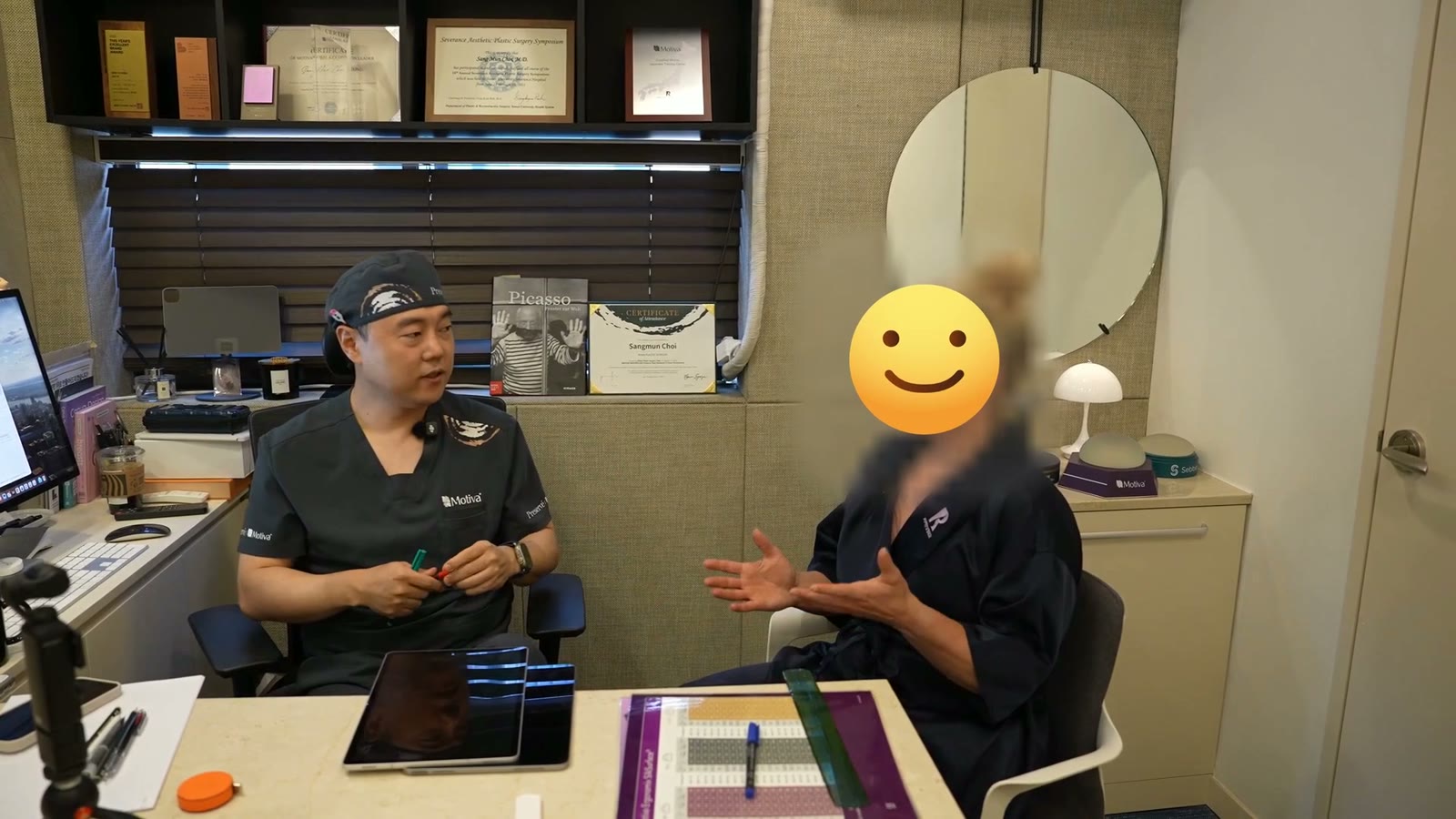
She said this in my consultation room, looking at the surgical markings in the mirror. She had lived with the asymmetry for years. She had trained through it: thirteen years of CrossFit, with implants sitting under her pectoral muscles.
She flew from the United States to Seoul for a revision, and she told only her sister she was coming. This is the story of her surgery, and of one specific decision inside it: moving the implants from under the muscle to over it.
I share it because “under or over the muscle” is one of the questions I am asked most often by international patients, and an actual case explains the trade-offs better than a diagram. One case is one case. Her anatomy made this the right call for her; it is not the right call for everyone, and I will say where it isn’t.
What you will learn
- Why submuscular implants can interfere with training in athletic patients
- How ultrasound findings and muscle thickness changed the plan
- What “repositioning the implant above the muscle” involves, including muscle repair
- What her first hour after surgery looked like, and what that does and does not prove
Quick answer
An athletic patient with submuscular implants had them repositioned above the muscle. Her pectoral muscles were repaired back onto the chest wall, the original incision lines were reused, and the implants were exchanged for Motiva Mini, 275cc on the left and 260cc on the right, with the final volumes confirmed using sizers during surgery. One hour after surgery she reported no pain and a noticeably softer feel. Recovery and results differ from person to person, and the over-the-muscle plane is not suitable for every body type.
The problem: implants that fought her training
Her first augmentation was done years ago in the United States, under the muscle. For an inactive patient that plane can work well for a long time. She was not an inactive patient.
Every time she pressed, pushed, or swung, her pectoral muscles contracted over the implants. In the exam room I asked her to flex. Her own words: “They are really uneven.”
Two things had happened over the years. First, muscle contraction had pushed the implants outward and apart, toward the armpits. Second, the two sides had drifted differently. She is right-handed, and on her dominant side the implant had migrated further downward and outward. This is a pattern I see in patients who train seriously: the muscle does exactly what muscle does, thousands of repetitions at a time, and the implant sits in its path.
What bothered her most was not cosmetic. “I’m excited not to have them interfere with my workouts,” she told me before surgery. “Not to hit my arm every time I move my arm.”

The exam: what ultrasound added
Before deciding anything I examined her with ultrasound. Two findings mattered.
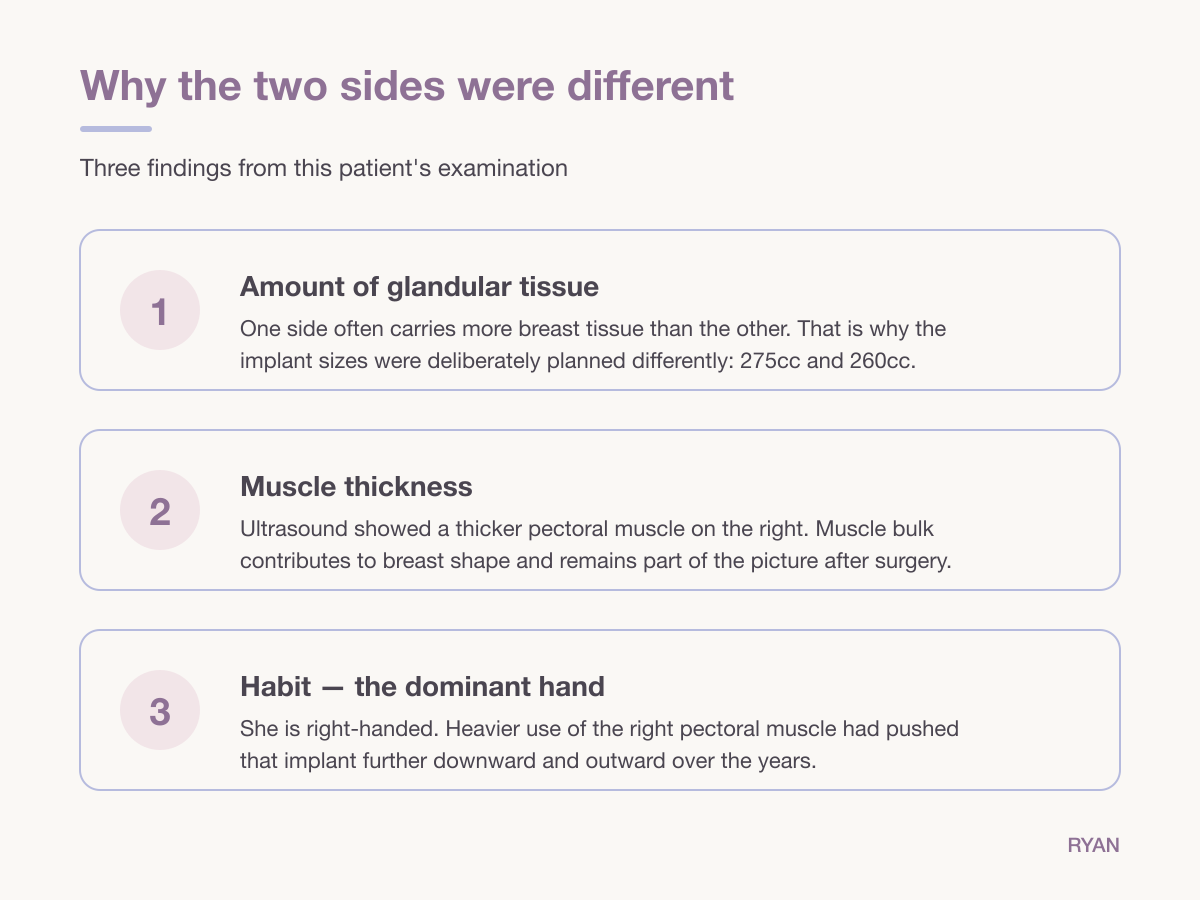
Her right pectoral muscle was thicker than her left. That asymmetry in muscle bulk contributes to asymmetry in breast shape, and it would remain after surgery, so the plan had to account for it rather than pretend the two sides were the same.
She also had more glandular tissue on the right side. Volume is implant plus your own tissue, so matching the final look sometimes means deliberately choosing different implant sizes. We planned 275cc for the left and one size smaller, 260cc, for the right, and I confirmed the choice during surgery with balloon sizers before opening the actual implants. I also told her plainly that 100 percent symmetry is not a promise anyone can honestly make. The goal was natural and balanced.
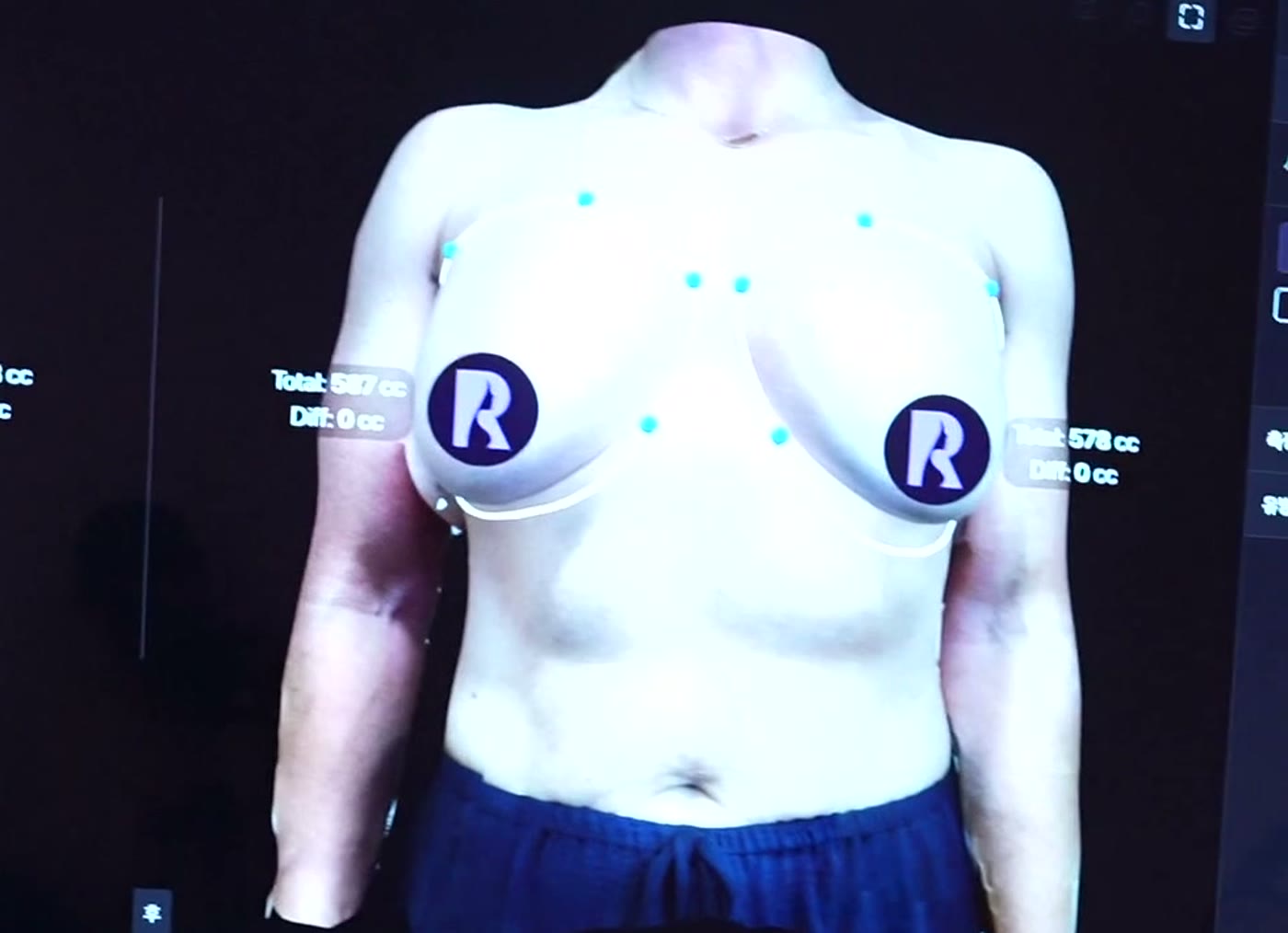
One more thing from the same exam: I checked her screening status and told her a mammogram would be fine from the following month, with a routine check once a year. A revision consultation is also a chance to put long-term surveillance in order.
The design: reusing what was already there
She had existing scars from her first surgery. We reused them. The red line in her markings followed her old incision, and the new plan was drawn as a curve from that line, opening space toward the center and the upper pole, where her previous result had never given her fullness.
This is the moment she saw her own asymmetry clearly for the first time, standing in front of the mirror with the lines drawn. Patients often live with a shape so long that it becomes invisible to them. The markings make it visible, and that conversation before surgery is worth more than any conversation after it.
The plan: over the muscle, and the muscle goes back to work
On the morning of surgery I summarized the plan to her in one sentence: today we change your implant position from under the muscle to above the muscle.
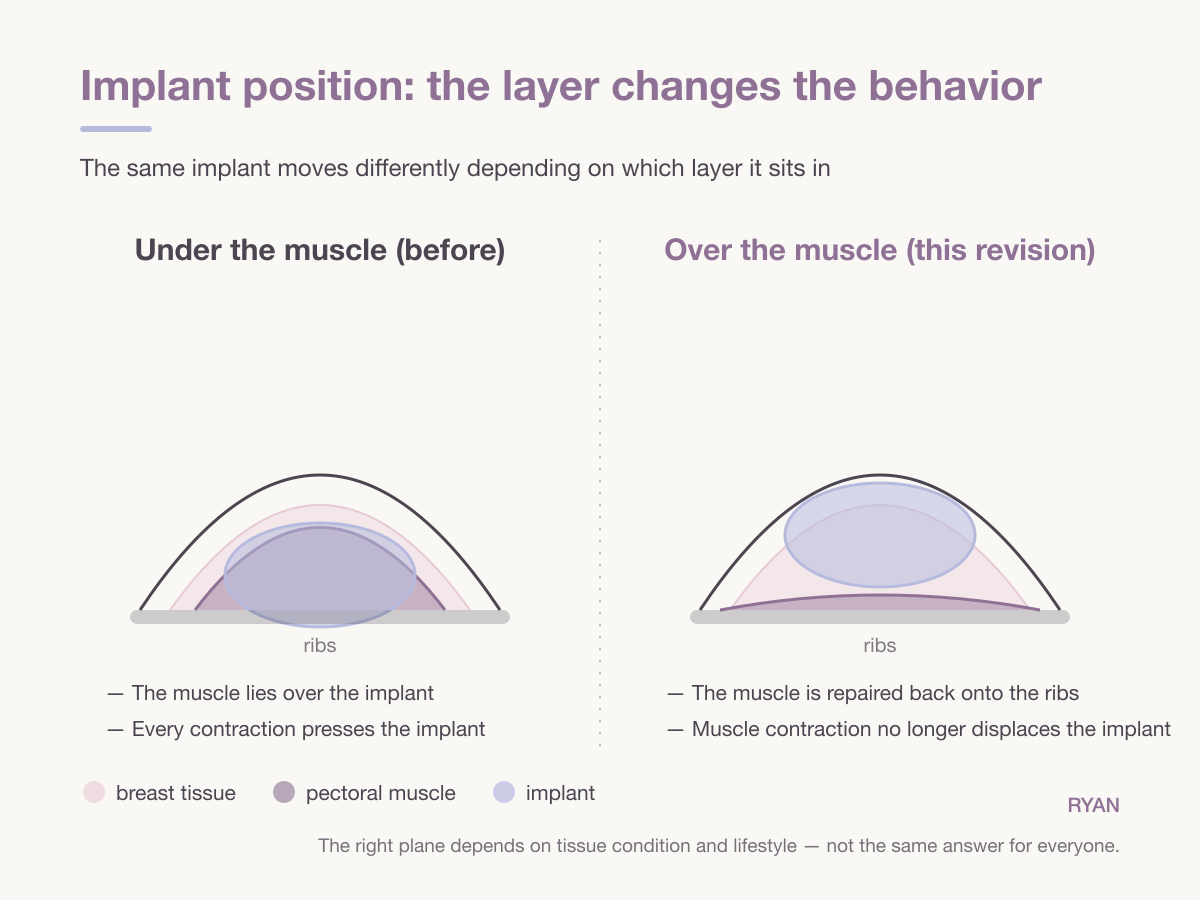
The part of that sentence people miss is what happens to the muscle. It is not simply left where the first surgeon put it. I repaired the pectoral muscle back down onto the chest wall, restoring it toward its original anatomy. The muscle returns to being a muscle: it can contract against the ribs the way it was designed to, which is why bench press and push-ups stop being a problem for the implant. The implant, sitting above it, no longer takes that force.
There is a second, less discussed benefit. An implant lying in a clean plane above the muscle produces a tidier picture on MRI years later, which makes long-term implant surveillance easier to read.
I did tell her, as I finished explaining: “Making your breasts great again.” She laughed. You are allowed to laugh on the morning of your surgery.
One hour after surgery
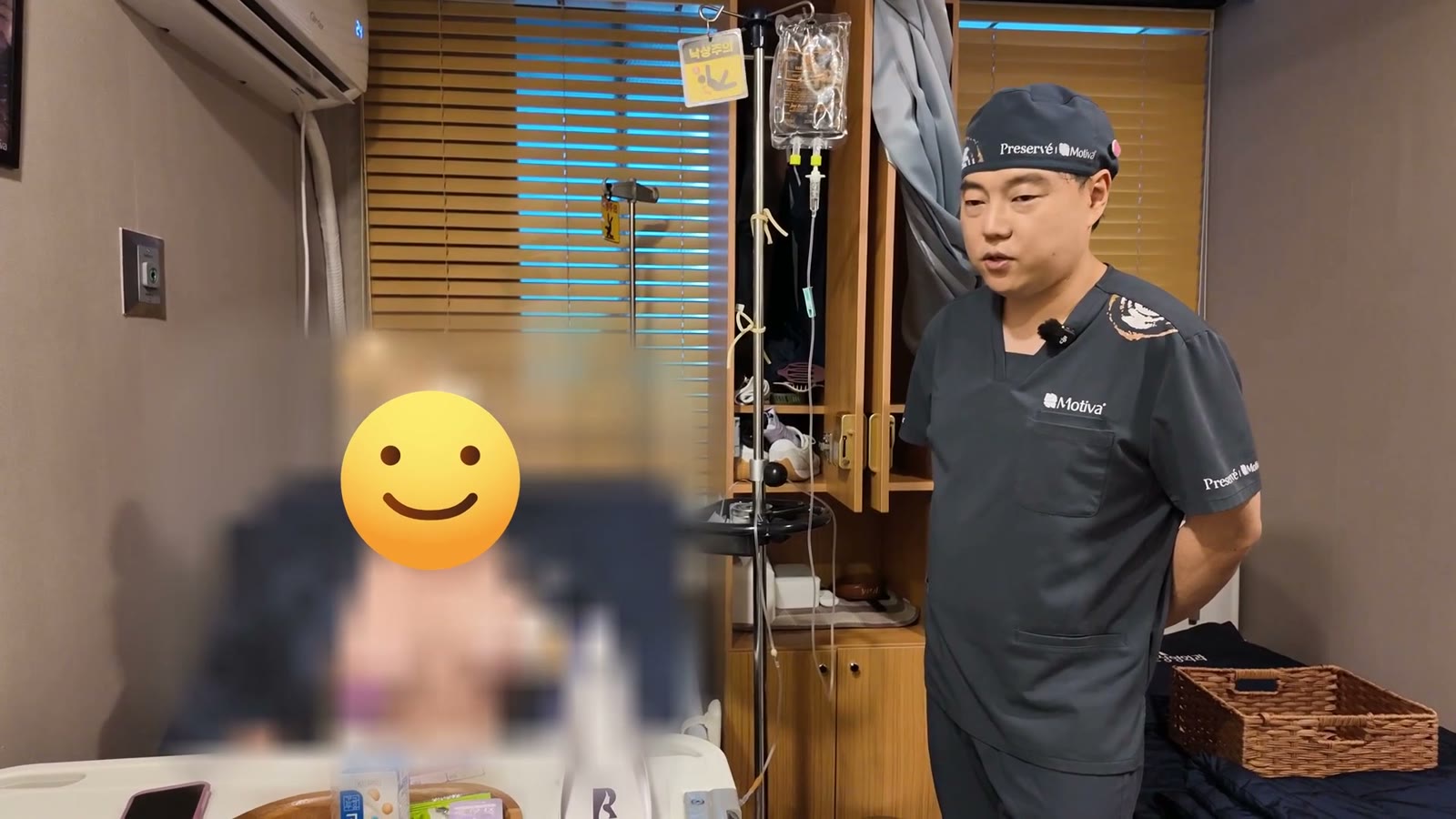
We filmed her first check, about an hour after she woke up. She pressed on her own breast and her reaction was immediate: “Oh my gosh. That is way softer than I had before. The ones I had before, I couldn’t push like this.”
She reported no pain at that first check. I want to be careful here, because pain is individual and I do not promise painless surgery to anyone. What I can explain is the mechanism: during the revision I preserved the muscle layer and surrounding tissue as much as possible instead of cutting new planes, and less disrupted tissue generally means less to hurt. Her first surgery had left her in pain for days. This time was different for her. Your experience would be your own.
The other details from that hour:
- The breasts sat closer together, with a natural curve instead of upper-pole bulging, and, in her words, “not in my armpit anymore.”
- The incision reused her old scar line and came out slightly over an inch, shorter than her original.
- There were no external stitches to remove. The incision was closed under the skin with absorbable sutures, so she was allowed to shower the same evening. “I did not know that there were no stitches,” she said. Her first surgery had kept her dry for days.
- I told her that if nothing went wrong overnight, no inflammation, no problem, she was medically clear to fly home the next day. She chose to stay a few more days for follow-up checks, which is what I recommend to international patients when their schedule allows it.
At the final check I showed her the old implants we had removed, and the before photos next to what she saw in the mirror. Lying down, sitting up, the implants stayed in place instead of sliding outward.
Is over the muscle right for everyone? No.
If this article convinces you that everyone should move their implants above the muscle, I have written it badly.
The over-the-muscle plane needs enough of your own tissue to cover the implant. In a very thin patient with little breast tissue, that plane can mean visible rippling and edges, and under the muscle remains the better protection. Existing capsule condition, skin quality, sagging, and what was done in the first surgery all change the answer. This patient had adequate tissue coverage, a strong training history that made muscle function a priority, and implants already causing plane-specific problems. That combination is what made the decision, not a general rule.
There is no answer that fits everyone. But for each patient, there is a choice that favors them. Finding it is the actual work of a revision consultation.
Why she chose to fly here

After surgery I asked her whether it had been worth traveling from the United States for this. “A hundred percent. Totally worth it.” She had lived in Korea before, during her military service, so the country itself did not intimidate her, and her sister trusted that she would be looked after here.
But her answer about the clinic was the one I keep thinking about: “Every clinic has their stories. You were able to educate me on why it was a better choice. It was about the science behind my body structure. I just felt very safe.”
That is the standard I would hold any surgeon to, including me, and including anyone you consult in your own country. If you leave a consultation knowing what will be done to your anatomy and why, you were consulted. If you leave with a price and a date, you were sold to.
If you are considering a revision and your first surgery was done abroad, start by gathering your records: the operative report, your implant card, and any imaging. I have written a separate guide on exactly what to bring.

This article describes one patient’s experience, shared with her consent, with identifying details withheld. It is general information, not medical advice. Surgical outcomes, recovery, and the appropriate implant plane vary with individual anatomy; a decision about revision surgery should be made through an in-person examination and consultation with a qualified surgeon.
Sangmun Choi, MD, PhD is a board-certified plastic surgeon in Seoul practicing breast surgery at Ryan Plastic Surgery Clinic.