Your operation in Seoul is behind you, and a long flight home is ahead. When is it reasonable to board, and what should you do once you are in the air?
What you will learn
- Why surgeons ask you to wait before a long flight.
- How to lower blood clot risk on the plane.
- What cabin pressure and airport scanners mean for implants.

In this guide
How soon can you fly after breast augmentation?
There is no single date that suits every patient. Published patient guidance offers a general starting point, not a booking rule, and the sources do not say exactly the same thing.
| Source | Suggested wait | Keep in mind |
|---|---|---|
| ASPS | 5 to 7 days after body procedures such as breast augmentation. [1] | General advice, not specific to your route or operation. |
| NHS | 5 to 7 days after procedures such as breast surgery. [2] | Written for anyone having cosmetic surgery abroad. |
| CDC Yellow Book | No flying for 10 days after chest or abdominal surgery. [3] | Does not single out breast augmentation. |
None of these sources knows your incision, implant pocket, medical history or the length of your flight. That is why the final answer should come from the surgeon who examined you, and why it may differ from a friend’s experience or a clinic blog.
Why wait at all? The first days after surgery are when problems are easiest to manage close to your surgical team: bleeding or a collection of fluid, swelling on one side, early signs of infection, and wound concerns. A follow-up visit before you leave lets your surgeon look for these and confirm that you are moving comfortably. ASPS notes that follow-up after cosmetic surgery abroad may be limited once a patient returns home. [1]
Blood clots are the other reason. CDC notes that surgery and air travel each increase the risk of blood clots, and that travel after surgery increases it further. [3] Reduced activity during recovery and many hours in a cabin seat point in the same direction.
Our guide on how long to stay in Korea after breast augmentation explains how international patients plan the stay around early follow-up. If you can, choose a ticket you can change, because the right day may move.
Before you book the flight home
- Your surgeon has examined you and said you may fly.
- You know when and how your next check will happen.
- Your implant card and records are in your carry-on.
- Medicine instructions are written in English.
- You have a doctor to contact at home if needed.
- Your ticket can be changed if recovery is slower.
A checklist supports, but does not replace, your surgeon’s clearance.
On the plane: lower your blood clot risk
For travel-related clots, CDC’s travel medicine guidance most often uses a journey of more than four hours as the threshold, and lists recent surgery as a risk factor. Many routes home from Seoul are far longer. [4]
Simple measures are reasonable for long-distance travellers: walk in the aisle regularly, exercise your calf muscles while seated, and consider an aisle seat, which may make moving easier. [4] The NHS adds drinking plenty of water, avoiding alcohol and wearing loose clothing. [5]
Compression stockings are a decision for your doctor, not an automatic purchase. CDC describes properly fitted below-the-knee stockings for travellers at increased risk. Do not start aspirin or another blood thinner for the flight unless a doctor has told you to. [4] Keep taking any medicines you were prescribed as instructed.
Protect your chest and arms as well. Pack light, use a bag with wheels, and ask a companion or airline staff to lift luggage into the overhead bin. Follow the lifting limits in your discharge instructions, even if you feel well.
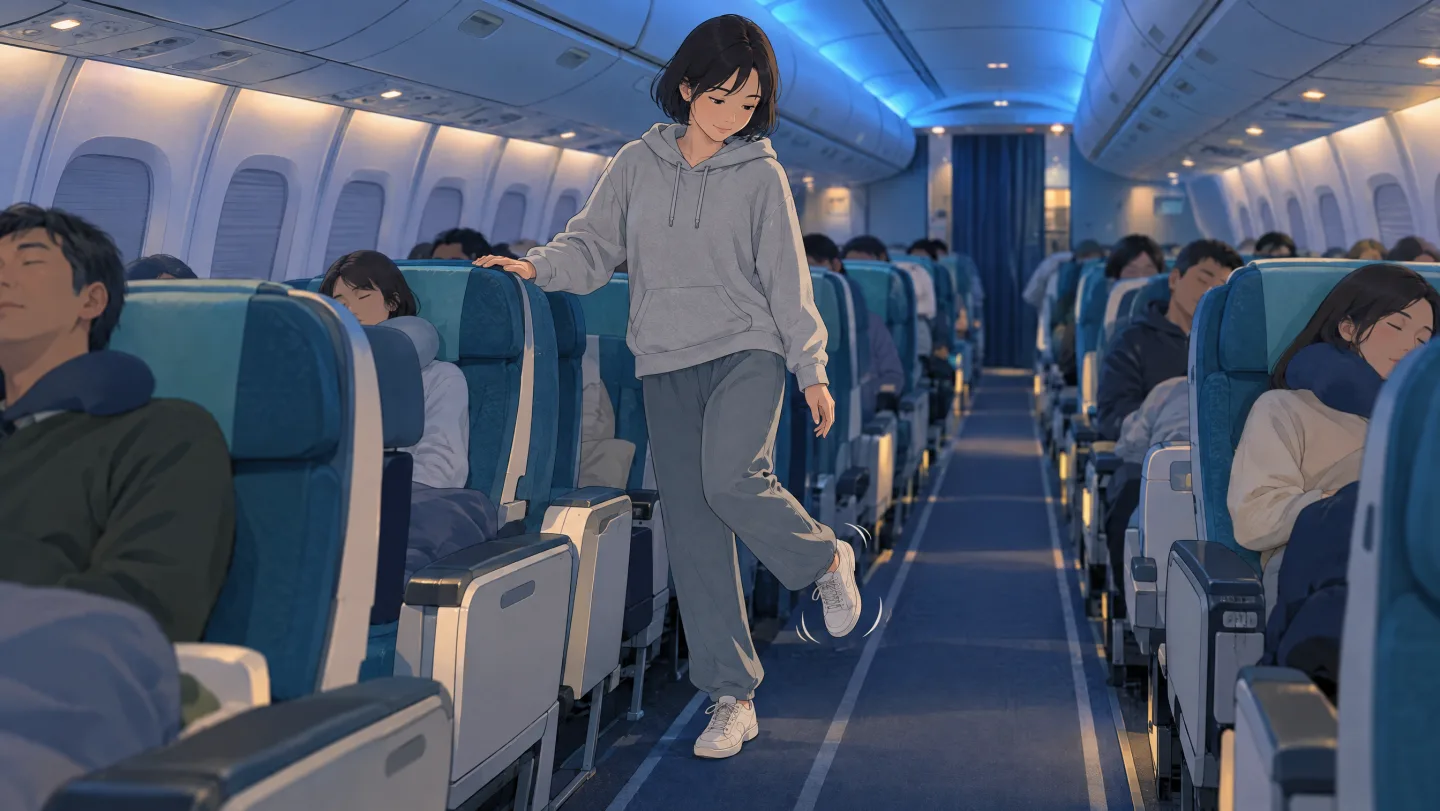
A simple routine for a long flight
- Before boardingWalk to the gate, drink water and wear loose clothing. Keep medicines and records with you.
- During the flightStand and walk regularly when it is safe. Flex your ankles and calves while seated.
- After landingKeep moving gently, rest at home and watch for warning signs over the following days.
Always follow crew instructions when the seat belt sign is on.
What to keep in your carry-on
Put the documents a doctor would need in the bag that stays with you, not in checked luggage. CDC advises medical tourists to request copies of their overseas medical records in English before returning home. [3]
- Your implant card, with the style, size and serial or lot numbers.
- Your discharge summary and operation note.
- A list of medicines and doses, and the medicines themselves.
- Your surgeon’s contact details and how to send photos or questions.
- Instructions for wound care, garments and activity.
- The date and format of your next check.
Ryan Plastic Surgery Clinic issues implant cards and records. Our implant card and records guide explains which details matter, sometimes many years later.
Does altitude affect breast implants?
Aircraft cabins are pressurised, but not to sea level. CDC describes cabin pressure as equivalent to about 6,000 to 8,000 feet (1,830 to 2,440 m). [6] Gas expands as pressure falls, which is why many patients ask about their implants.
The evidence is limited, and much of it is old or indirect. A 1988 laboratory study exposed implants to simulated dives followed by altitude. Bubbles and volume changes occurred, but the authors judged that the conditions needed to cause this in the body were extremely unlikely in normal circumstances. [7]
Scans sometimes show a little gas around implants after travel. In a study of 321 chest CT scans at a Denver centre, about a mile above sea level, 17.1% showed gas around the implant. It was associated with living outside Colorado, silicone implants and implant rupture, but not with infection. The authors concluded that such gas can be dismissed when there are no other associated findings. [8]
A 2018 systematic review of air travel after breast cancer surgery found that reported adverse effects on implants were limited to case reports and laboratory experiments. [9] We found no evidence that an intact implant explodes from normal cabin pressure. The research base is small, however, so a new change in shape, size, pain or swelling after a flight still deserves a check.
Airport security and body scanners
Many patients want to know two things: will the scanner show something, and will they have to explain? We could not find official TSA guidance written specifically about breast implants, so this section sticks to what TSA does publish.
TSA’s body scanners, called advanced imaging technology, use automated software that marks possible items on a generic outline of a person, the same for every traveller, rather than a passenger-specific image. Areas that may need more screening are highlighted. Most travellers may decline the scanner in favour of physical screening, which generally means a pat-down. [11]
You may tell the officer about a medical condition verbally or with a TSA notification card, and you may ask for private screening with a witness of your choice. [10] If your chest is still tender, saying so before a pat-down is reasonable. Equipment and procedures differ between countries and airports, so follow the instructions of local security staff when you leave Korea and when you connect.
Travel insurance and follow-up at home
Ordinary travel insurance may not cover what you need. The NHS warns that travel insurance does not normally cover problems arising from surgery. [2] CDC notes that some travellers may need supplemental medical cover, including medical evacuation, and that cover should include necessary follow-up care. [3] Before you travel, ask the insurer in writing whether complications of elective surgery, treatment abroad and a changed flight are covered.
Arrange a local contact before you leave Korea, such as a family doctor or a plastic surgeon willing to see you if needed. CDC advises coordinating local follow-up care before travel. [3] Agree with your Seoul team how photos, questions and scheduled reviews will work once you are home.

Our long-term follow-up guide explains which checks belong in the first weeks and which matter years later. For the weeks after you land, our guide to the recovery timeline for sleeping, driving and exercise and our explanation of how implants drop and fluff after surgery describe what often changes at home.
The bottom line
Fly when your surgeon has examined you and says you are ready, not on a date taken from a general list. Keep your ticket flexible, move often in the air, carry your records and know which symptoms need urgent care after landing. Current evidence does not suggest that normal cabin pressure is a common problem for implants; blood clots, wound care and follow-up deserve more of your planning.
Three common questions
Can I fly 2 or 3 days after breast augmentation?
Patient guidance from ASPS and the NHS suggests waiting about 5 to 7 days after breast surgery before flying. Flying earlier is a decision only your own surgeon can make after examining you.
Can airport body scanners see breast implants?
TSA says its body scanners mark possible items on a generic outline of a person, not a personal image. We found no TSA guidance written specifically about breast implants. You may tell the officer and ask for private screening.
Can breast implants burst on a plane?
We found no evidence that intact implants burst from normal cabin pressure. Research on altitude is limited, so have any new swelling, pain or change in shape after a flight checked by a doctor.
Plan the journey home with your surgeon
Ask Ryan Plastic Surgery Clinic in Seoul about follow-up and travel planning before you book your flights. An online enquiry does not replace an examination or urgent local care.
Contact Ryan Plastic Surgery ClinicSources and evidence notes
- ASPS: briefing paper on cosmetic surgery tourism. Suggests waiting 5 to 7 days before flying after body procedures such as breast augmentation; notes limited follow-up after return home.
- NHS: cosmetic surgery abroad. Advises against flying for 5 to 7 days after procedures such as breast surgery; travel insurance does not normally cover surgical complications.
- CDC Yellow Book 2026: medical tourism. Surgery and air travel each raise clot risk; no flying for 10 days after chest or abdominal surgery; records in English, local follow-up and supplemental insurance.
- CDC Yellow Book 2026: deep vein thrombosis and pulmonary embolism. Travel over 4 hours, recent surgery as a risk factor, walking, calf exercises, aisle seat, and stockings for travellers at increased risk.
- NHS: deep vein thrombosis. Symptoms, emergency signs such as breathlessness or chest pain, and tips for long journeys.
- CDC Yellow Book 2026: air travel. Cabin pressure is maintained at an equivalent of about 6,000 to 8,000 feet.
- Vann et al., 1988: mammary implants, diving, and altitude exposure. In vitro study; Plast Reconstr Surg 81(2):200–3. This draft cites the indexed abstract.
- Brown et al., 2015: peri-implant breast gas at high altitudes. Retrospective review of 321 chest CT examinations in Denver; AJR 205(5):971–5. This draft cites the indexed abstract.
- Co et al., 2018: air travel safety after breast cancer surgery, a systematic review. Effects on implants limited to case reports and ex vivo experiments; not a study of cosmetic augmentation.
- TSA: disabilities and medical conditions. Notification card, private screening with a witness, and pat-down procedures.
- TSA: security screening. Advanced imaging technology, generic outline display and the option of physical screening. US procedures only.
Educational information, not a diagnosis or individual treatment recommendation. Outcomes vary and surgery has risks. Illustrations are not photographs of actual patients and do not depict treatment results.