Breast Implant Decisions and Follow-Up, Part 4 of 9
If you travel to Seoul for breast augmentation, how do you know which checks belong in the first week, which can happen at home, and which still matter years later?
What you will learn
- How early recovery reviews differ from long-term implant surveillance
- When ultrasound, MRI, and routine mammography may enter the plan
- What international patients should keep and when a new symptom needs review
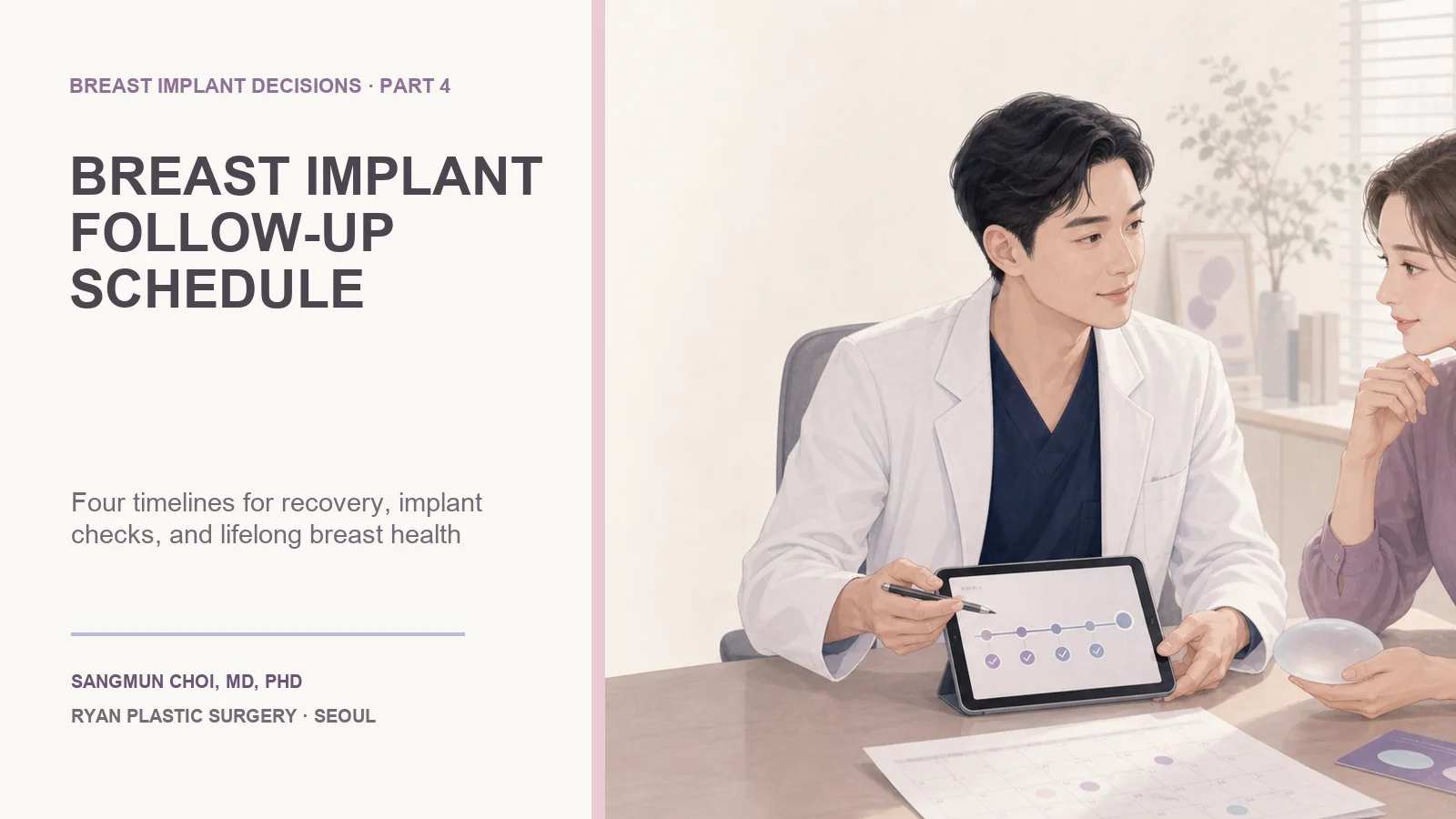
I am Sangmun Choi, MD, PhD (최상문 박사, 라이안성형외과), a plastic surgeon at Ryan Plastic Surgery Clinic in Seoul. A useful follow-up plan is not one endless list of appointments. It is several timelines running together: healing after surgery, the way the breast settles, surveillance of the implant, and ordinary breast-health screening.
Quick Answer
After breast augmentation in Korea, early visits should follow your surgeon’s operation-specific instructions. For asymptomatic silicone implants, current FDA and ACR guidance describes ultrasound or non-contrast MRI beginning 5–6 years after placement and then every 2–3 years. Symptoms can move evaluation earlier, and this implant imaging does not replace age- and risk-based breast cancer screening.
Table of contents
1. Why a Breast Implant Follow-Up Schedule Has Four Tracks
Patients sometimes hear “follow-up” and assume it means only a wound check. That is the first track, not the whole journey. Each track answers a different question:
- Healing: Are the incision, swelling, pain, and early movement progressing as expected for this operation?
- Settling: How are shape, softness, scars, sensation, and activity changing over the first months?
- Implant integrity: Is imaging due, or is there a symptom that may justify earlier ultrasound or MRI?
- Breast health: What cancer screening is appropriate for your age, risk, and national guideline?
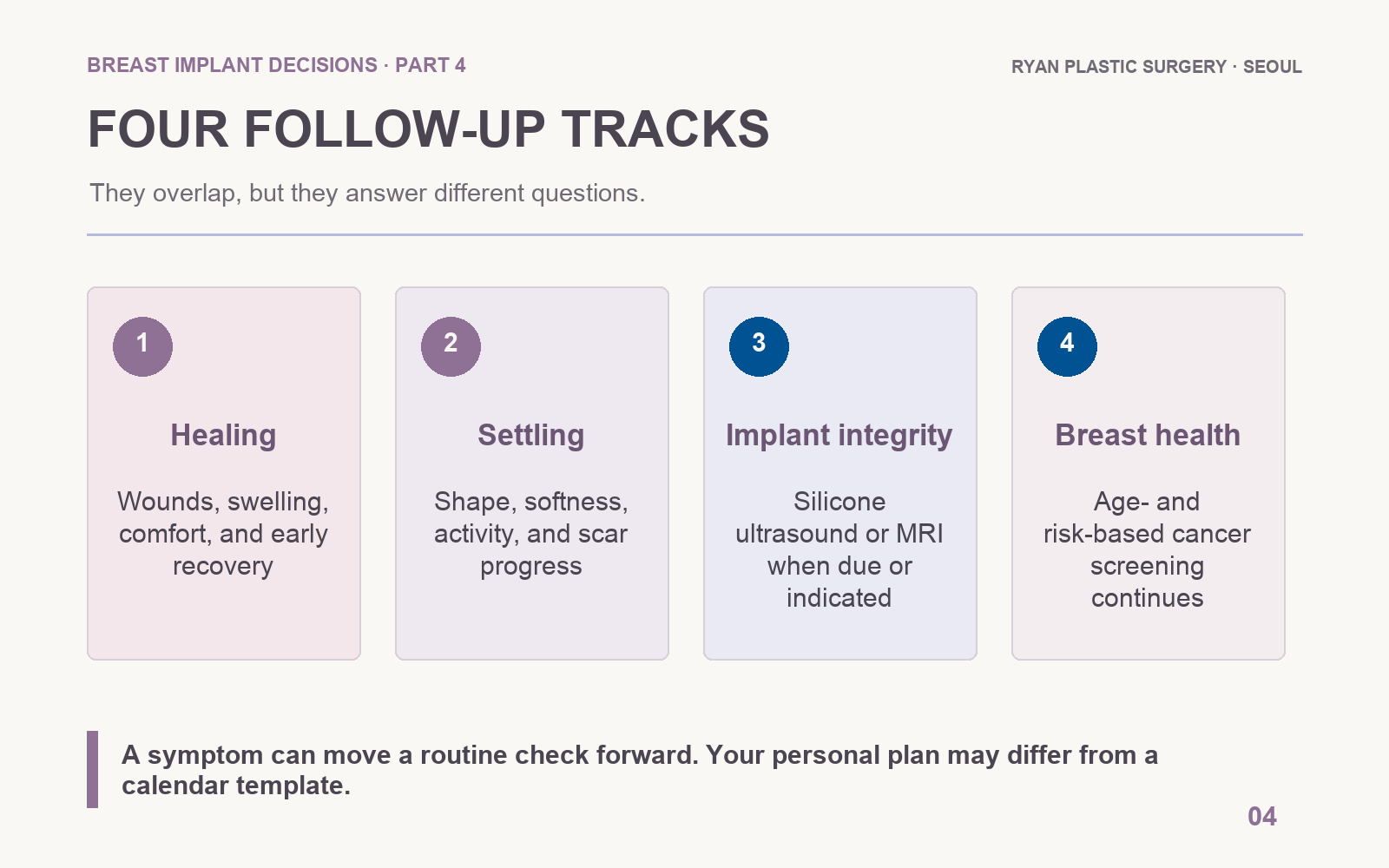
These tracks overlap. For example, a new one-sided swelling years after surgery is not simply a routine calendar item; it may require clinical assessment and targeted imaging. Conversely, a stable breast with no symptoms still needs ordinary breast screening based on the person’s age and risk.
2. The First Days and Weeks: Follow the Operation, Not a Generic Calendar
The earliest schedule depends on the incision, pocket, any fat grafting or lift, wound condition, medical history, and travel plan. A surgeon may review the incision, swelling, bruising, comfort, arm movement, support garment, medications, and warning signs. Another patient may need a different sequence, so internet calendars should not override the discharge plan.
Many international patients at Ryan Plastic Surgery Clinic plan to stay in Seoul for roughly one week. When medically appropriate, that stay may allow an early in-person review before the flight home. Staying longer can provide more opportunity to observe the early course, but it cannot remove every possibility of bleeding, infection, wound problems, or another complication. Flight timing and follow-up should be individualized.
3. The First Months and Later Years: What Changes
During the first months, the useful questions are usually about settling rather than device age: Is swelling decreasing? Is the scar maturing? Is activity becoming more comfortable? Are the breasts changing in a reasonably steady way? Photos may help document change, but lighting, posture, and camera distance should be kept similar.
Later, the plan becomes less about frequent routine visits and more about symptom awareness, implant information, breast screening, and imaging when due. Breast implants are not lifetime devices, according to the FDA, but that does not mean every implant must be replaced automatically at a fixed birthday. Revision may be considered for a diagnosed problem, an aesthetic change, or a patient’s informed preference.
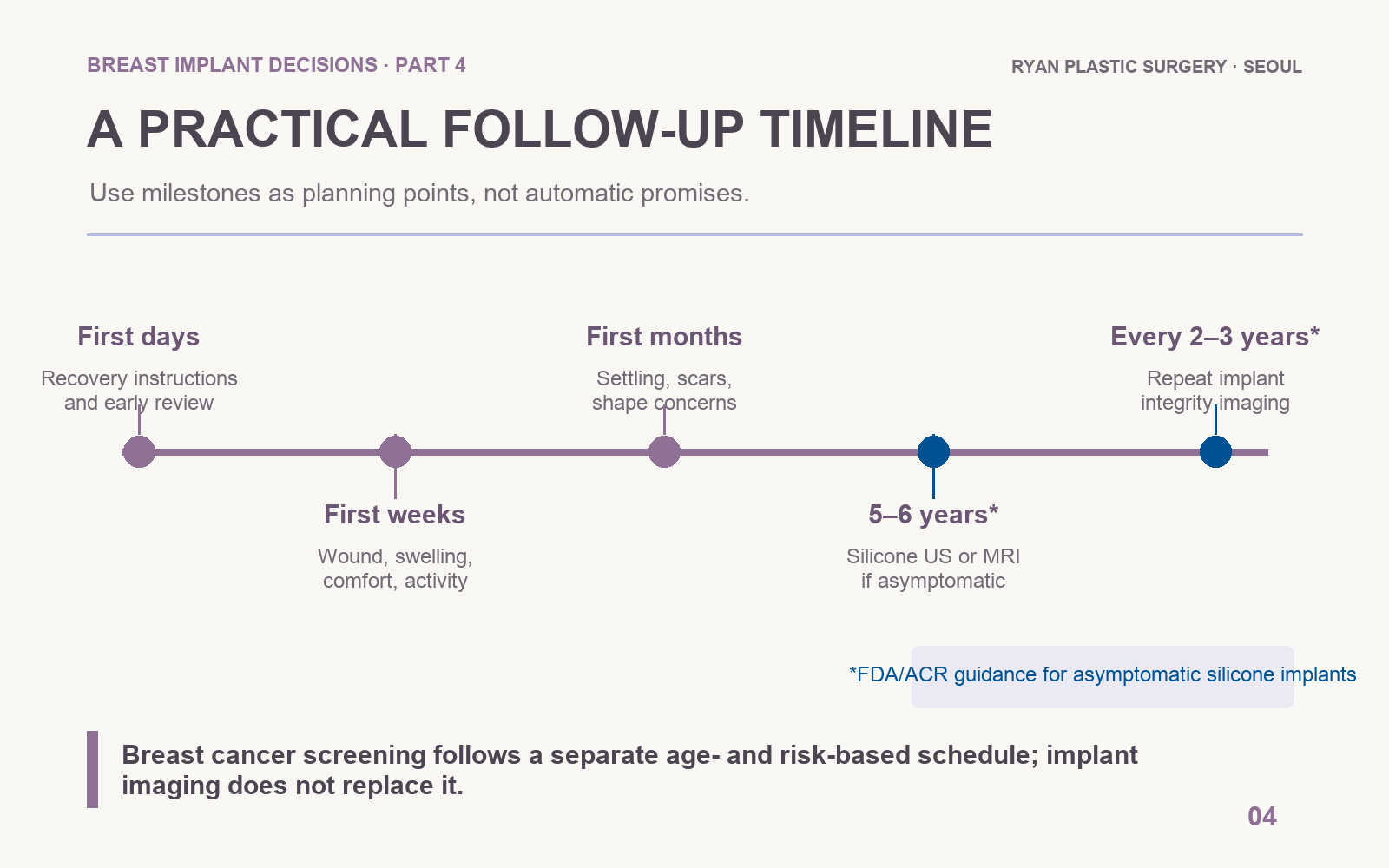
| Time or trigger | Main purpose | What may be reviewed | Important limit |
|---|---|---|---|
| First days | Early recovery | Wound, swelling, pain, medication, warning signs | The exact visit date depends on the operation and clinical course |
| First weeks | Healing and activity | Incision progress, support, movement, travel questions | Remote photos cannot rule out every complication |
| First months | Settling | Shape, softness, scars, sensation, activity progression | One snapshot cannot show the full trend |
| 5–6 years after silicone implantation | Asymptomatic implant integrity surveillance | Ultrasound or non-contrast MRI under current FDA/ACR guidance | Earlier imaging may be needed if symptoms or uncertainty appear |
| Every 2–3 years after the first surveillance study | Ongoing silicone implant surveillance | Repeat ultrasound or non-contrast MRI | This does not replace routine breast cancer screening |
| At any time with a concerning change | Diagnostic assessment | In-person examination and appropriate imaging | Do not wait for the next routine milestone when symptoms are progressing |
4. When Are Ultrasound and MRI Used?
For an asymptomatic person with silicone implants, the FDA’s labeling recommendations describe a first ultrasound or MRI at 5–6 years and repeat imaging every 2–3 years. The ACR Appropriateness Criteria similarly rates ultrasound or non-contrast MRI as usually appropriate at those intervals. Before five years, routine implant imaging is generally not the default for an asymptomatic silicone implant under that guidance.
Symptoms change the question. MRI is the most effective method for detecting silent silicone rupture, while ultrasound is an accepted alternative for asymptomatic screening. If an ultrasound result is uncertain or a patient has symptoms, MRI may be recommended. The correct study can also depend on implant type, age, pregnancy status, local availability, and the clinical concern.
5. Mammograms Are a Separate Breast-Health Schedule
Implant integrity surveillance and breast cancer screening are not interchangeable. A woman with implants should continue mammography or other screening according to the guidance used in her home country and her individual risk. The American Cancer Society advises telling the mammography facility about implants because additional implant-displacement views may be used.
Before booking, tell the imaging center the implant type and surgery date, and bring the device card if available. A screening mammogram looks mainly for breast disease; an implant-focused ultrasound or MRI asks a different question. A clinician may coordinate both when symptoms or risk factors make that appropriate.
6. How International Patients Can Continue Follow-Up at Home
Long-distance care works best when information moves with the patient. Keep your implant card, operative summary, implant brand and size, surgery date, medication list, allergy history, clinic contact details, symptom dates, and copies of imaging reports. The FDA notes that the device card contains identifying information such as implant style, size, and serial or lot number.
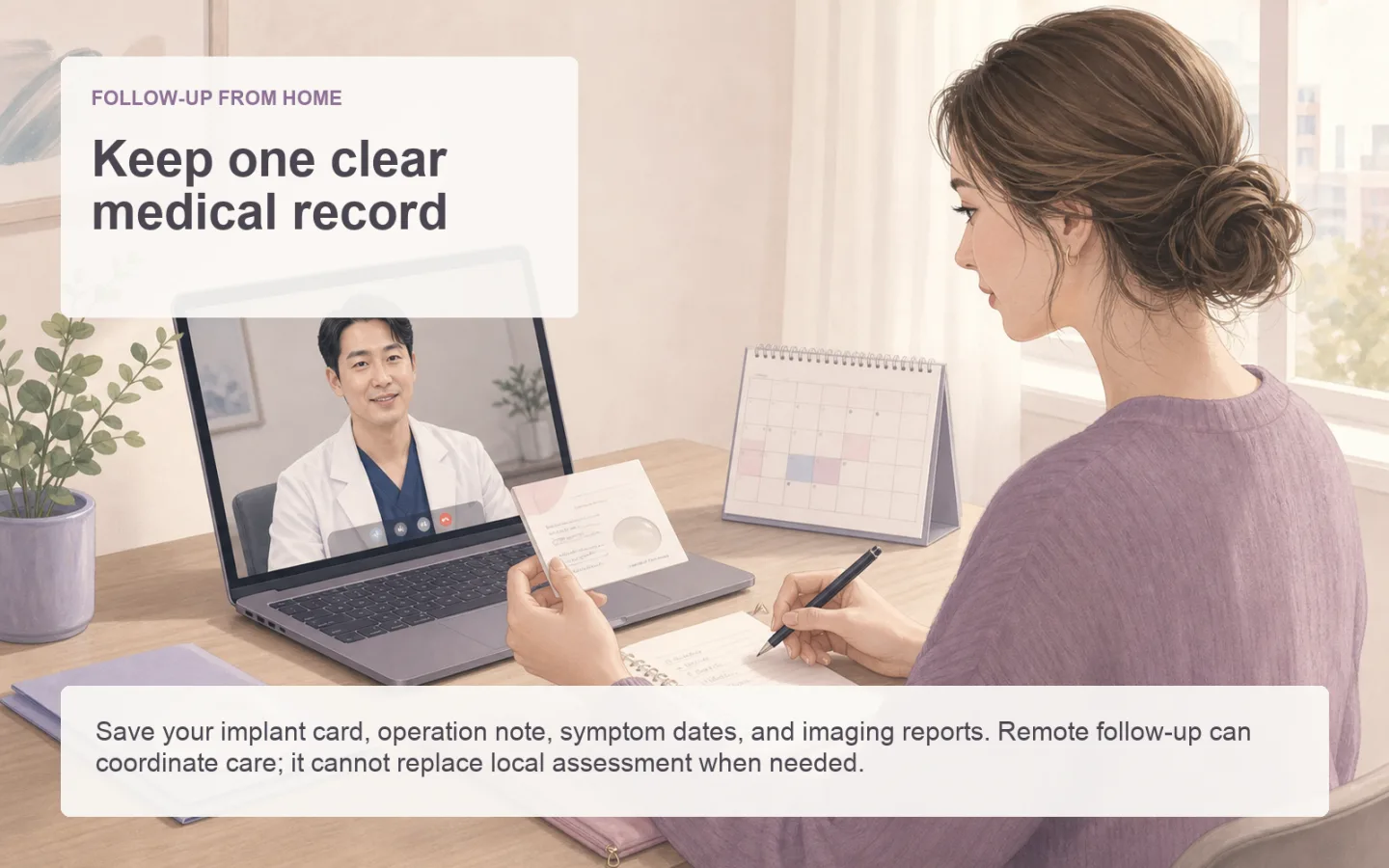
At Ryan Plastic Surgery Clinic, remote follow-up may help review a trend, organize photographs, and decide whether a local examination is needed. It cannot palpate a breast, measure vital signs, culture drainage, or perform imaging. When an in-person assessment is recommended, a local plastic surgeon, breast specialist, emergency service, or imaging center may need to take over promptly.
A simple follow-up file to keep
- Implant device card and operation date
- Operative note or concise surgical summary
- Baseline and follow-up photographs taken consistently
- Imaging reports and the actual image files when possible
- A dated symptom log, including what changed and how quickly
- Current medications, allergies, and contact details for both clinics
7. When a Symptom Should Move the Schedule Forward
A calendar is useful only while the clinical situation is stable. New persistent firmness, a contour shift, a mass, enlarged lymph nodes, increasing pain, or one-sided swelling should be discussed rather than saved for a distant routine visit. Rapid swelling, severe or worsening pain, fever, spreading redness or warmth, drainage, wound opening, or a breathing problem may require urgent local medical assessment.
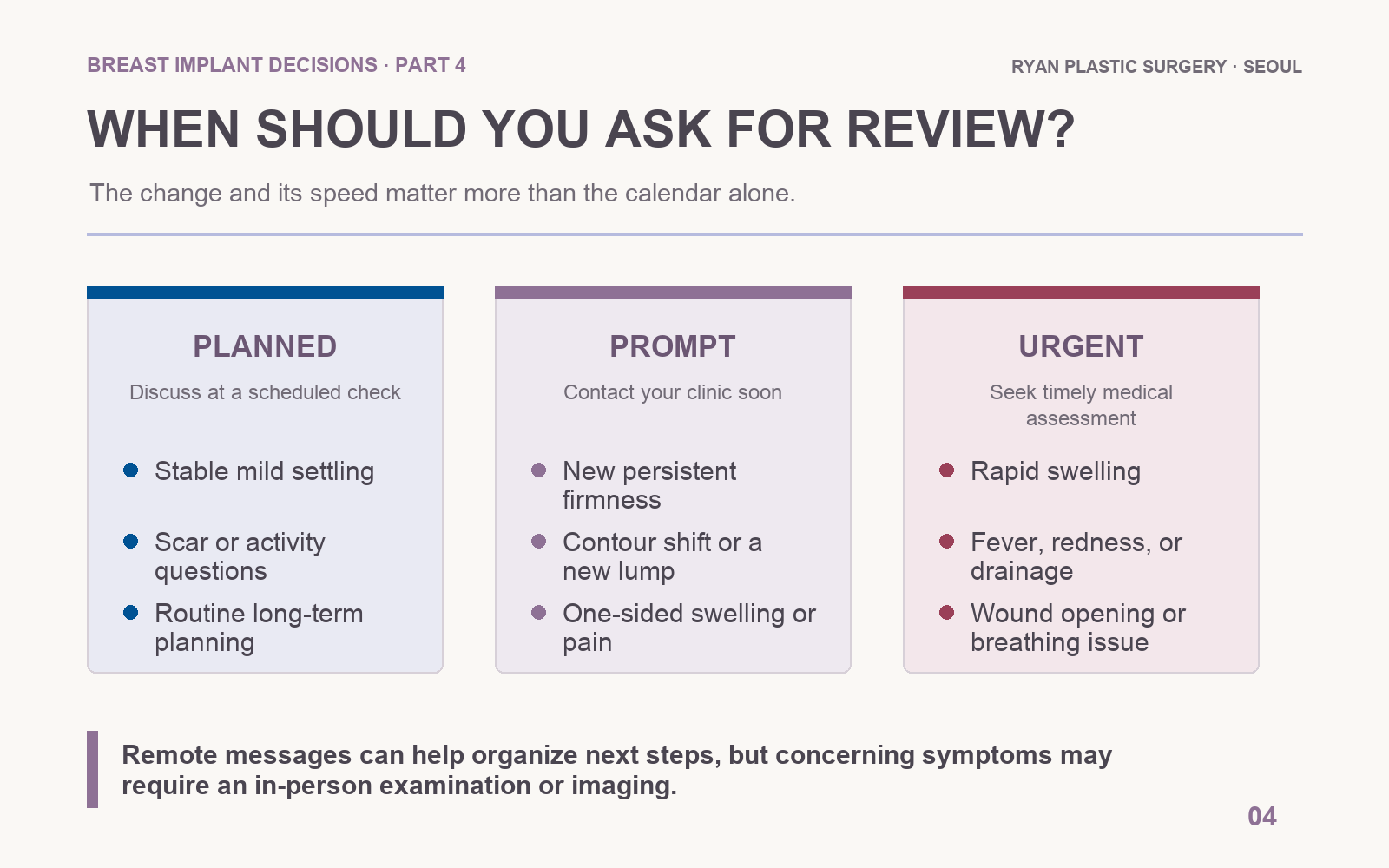
These signs do not prove rupture, infection, capsular contracture, or another diagnosis by themselves. They indicate that more information may be needed. An examination and targeted imaging can help separate implant-related issues from breast tissue, chest wall, skin, or unrelated causes.
A Follow-Up Plan You Can Actually Keep
The most practical breast implant follow-up schedule is written in four layers: the surgeon’s early recovery plan, milestone reviews as the breast settles, long-term implant surveillance, and ordinary breast-health screening. For international patients, the handover home should be planned before surgery, not improvised after a concern appears.
Your implant type, operation, symptoms, age, breast cancer risk, and local access to imaging can all change the details. Use the timeline as a conversation guide, then confirm the exact plan with the clinicians who know your case.
Frequently Asked Questions
How often should breast implants be checked after surgery?
Early checks should follow your surgeon’s operation-specific schedule. After healing, review may be symptom-led, while asymptomatic silicone implants have a separate imaging timeline: current FDA and ACR guidance describes ultrasound or non-contrast MRI at 5–6 years and every 2–3 years thereafter.
Do I need an MRI every year after breast augmentation?
Not routinely under current U.S. guidance for an asymptomatic silicone implant. Ultrasound or MRI is described at 5–6 years and then every 2–3 years. Symptoms, an uncertain ultrasound, implant type, or a clinician’s concern may justify a different plan.
Can an international patient complete follow-up from home?
Some routine communication and photo review may happen remotely, but remote care cannot replace examination or imaging when these are indicated. Keep your implant records and identify a local clinician or imaging center before surgery so care can continue after you return home.
Plan Surgery and Follow-Up as One Journey
If you are considering breast augmentation in Seoul, bring your travel dates, medical history, prior breast imaging, and long-term follow-up questions to the consultation. Ryan Plastic Surgery Clinic can help outline an individualized plan and the records you should carry home.
Request an individual consultationReferences
- U.S. Food and Drug Administration. Breast Implants: Certain Labeling Recommendations to Improve Patient Communication.
- American College of Radiology. ACR Appropriateness Criteria: Breast Implant Evaluation. Revised 2025.
- U.S. Food and Drug Administration. Risks and Complications of Breast Implants.
- U.S. Food and Drug Administration. What to Know About Breast Implants.
- American Cancer Society. Mammograms for Women with Breast Implants.
- American Society of Plastic Surgeons. Breast Augmentation Recovery.
Last medically reviewed: August 10, 2026
Medical disclaimer: This article provides general education and does not diagnose a condition or replace an individual examination. Follow-up timing may differ according to implant type, operation, symptoms, medical history, national screening guidance, and clinician judgment. Seek urgent local medical care for severe or rapidly worsening symptoms.
Pingback: Choose a Breast Surgeon in Seoul: 9 Safety Questions
Pingback: Fall Breast Surgery in Seoul: Week-by-Week Guide
Pingback: Breast Implant Removal in Korea: Replace, Lift, or Remove?