Reflecting on the Motiva Preservé Roundtable held in Seoul, Korea. A record of the brand’s journey told through data, and a dialogue centered on “women’s health.”
* This article is intended to provide general information based on a report from attending an academic event, and does not guarantee the efficacy or safety of any particular product or surgical technique. The assessments, outlooks, and product-related statements in the text reflect the views of the speakers and the company. Some products mentioned in this article may be unapproved in Japan, or their approval status may differ from country to country. All breast surgery carries the possibility of side effects and reoperation, and results vary from individual to individual. Whether a procedure is appropriate, and how it should be performed, must always be determined through an in-person consultation with a specialist.
Introduction
The author is a surgeon specializing in breast surgery based in Seoul, Korea.
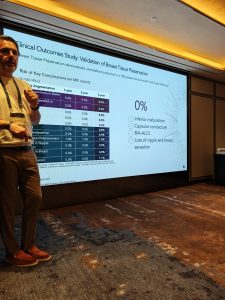
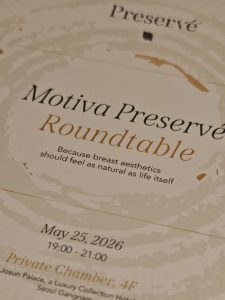
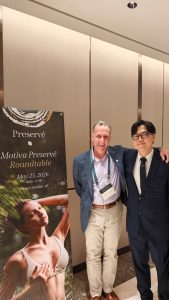
On May 25, 2026, I attended an academic event on breast surgery held in Seoul (the Motiva Preservé Roundtable, hosted by Motiva Korea). Rather than a venue for explaining a specific surgical technique in detail, this gathering was a time to look back, based on the latest data, at the journey Motiva has taken as a brand and where it is heading — and to discuss how to protect “women’s health.”
The speakers included Ivan Bilic, Senior Vice President (SVP) of Establishment Labs, the company behind the Motiva brand, who oversees the commercial division worldwide outside the United States; and Im Si-nyeong, the representative of Motiva Korea. Jo Potter, the new head for the Asia-Pacific region, also joined, and together they exchanged views on “women’s health” across regions.
This piece organizes what was discussed there as general information, in a way that may be helpful to readers in Japan as well. I hope you will read it with the understanding that it is an introduction to “the kind of discussion currently taking place in the industry,” and not a recommendation of any particular procedure.
Looking Back at the Brand’s Journey Through Data
What struck me in Mr. Bilic’s talk was the phrase, “To understand the future, you first need to look at the history.”
The company has been in the market since 2010 and is said to be used in roughly 100 countries today. The speakers looked back on that journey while presenting the latest data. A single product appears, refinements are layered on, and it expands into new fields such as reconstruction and minimally invasive approaches — that flow was organized by era.
What was emphasized here was not flashy “novelty,” but the fact that they have consistently kept looking in the same direction: minimizing the burden on the body as much as possible, and placing the health of the women receiving treatment at the center. The stance is that technology is a means to that end.
(* Regarding the advantages or specific effects of individual products, approval status differs by country and there are also advertising restrictions, so this article does not delve into them and limits itself to introducing the “direction of the brand.”)
The Direction Ahead — “Expanding the Range of Options”
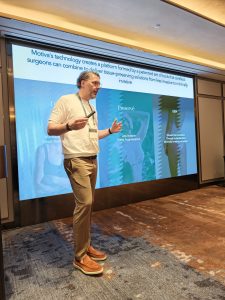
Regarding the future, what the speakers repeatedly touched on were the concepts of “minimally invasive” and “tissue preservation.”
Trying to approach surgery while preserving as much of the patient’s own tissue as possible — this direction overlaps with the larger trends in medicine as a whole (such as the shift from open surgery to laparoscopy in general surgery).
That said, what I think is important here, too, is that this is not a story of “one method being superior to another.” The range of options that can be considered is expanding according to each patient’s condition and goals — I think that is the accurate way to understand it. Which method is suitable varies from person to person, and also depends on the judgment of the operating surgeon.
The Central Theme — “Women’s Health”
Throughout this roundtable, what remained at its center was “women’s health.”
To put the idea the speakers shared in a single sentence: “Even if there is an opportunity to achieve something in the market, we will not pursue it at the expense of compromising women’s health.” As concrete initiatives, the following were introduced.
- Pink October — an annual breast cancer awareness initiative each October. It is said to place particular emphasis on breast reconstruction.
- The Africa Reconstruction Network — a non-profit activity in which a team of specialists visits regions where it is difficult to receive breast reconstruction, providing education and donations.
And in the dialogue with Jo Potter, the new head for the Asia-Pacific region, “women’s health” over a longer time horizon became a topic. The theme was how to watch over a woman and manage her health so that, after receiving an implant, she can spend the long years ahead with peace of mind. It was a discussion of how medical professionals and companies should confront women’s health issues, including breast cancer.
I Want to Convey This Accurately — Implants and “Ongoing Health Management”
In connection with this topic, there is an important point I would very much like patients to know.
Having a breast implant placed does not mean that regular screenings become unnecessary. Quite the opposite: regardless of whether you have an implant, breast cancer screening appropriate to your age and individual risk, as well as regular follow-up, are very important. If you have an implant, you need to discuss in advance with your physician how screening should proceed (such as the type of imaging examination).
Also, any breast surgery can be accompanied by side effects such as bleeding, infection, capsular contracture, implant-related complications, asymmetry, changes in sensation, and the possibility of reoperation. It is not “place it and you’re done” — continuing to watch over your own body afterward is what, in the end, I understood the “women’s health” discussed at the roundtable to mean.
In Closing
To learn new data and ways of thinking promptly at academic venues, and to convey that content in a balanced way to each individual patient in the consultation room — that, I believe, is the role of a physician.
What I felt anew through this gathering was that the field of breast surgery is moving in a direction that looks not only at “how large,” but at “how healthily a woman can live the rest of her life ahead.”
I hope to be able to bring such medical topics from Korea to readers in Japan. Thank you for reading.
Disclaimer / Please Note
- This article is general information based on a report from attending an academic event, and does not guarantee the efficacy or safety of any particular product or surgical technique.
- The assessments, outlooks, and product-related statements in the text reflect the views of the speakers and the company, and are not medical recommendations of the author or the author’s clinic.
- Some products mentioned may be unapproved in Japan. Advertising regarding the effects of unapproved medical devices or treatments is restricted by law, and this article limits itself to introducing factual matters.
- Regardless of whether you have a breast implant, breast cancer screening and regular follow-up are important. Please consult your physician about how screening should proceed.
- All breast surgery carries the possibility of side effects and reoperation, and results vary from individual to individual. Whether a procedure is appropriate, and how it should be performed, must always be determined through an in-person consultation with a specialist.
- This article is not intended to solicit individual treatment or to provide information on costs or reservations.
#CosmeticSurgery #BreastAugmentation #BreastSurgery #BreastImplants #WomensHealth #BreastCancerAwareness #Motiva #OverseasMedicine