I am Sangmun Choi, MD, PhD (최상문 박사, 라이안성형외과), a plastic surgeon in Seoul specializing in breast surgery and international patient care. Many patients have heard that breast implants must be replaced every 10 years. That statement is too simple.
Quick answer: Breast implants are not lifetime devices, but there is no universal expiration date and no automatic rule that every implant must be replaced at 10 years. Replacement is considered when there is a problem, a meaningful change, or a patient preference, together with appropriate long-term follow-up.

Why the “replace every 10 years” rule is misleading
The FDA explains that the longer a patient has breast implants, the greater the chance of complications that may require another operation. However, implant lifespan varies and cannot be predicted for an individual patient.
Some patients need revision earlier than 10 years. Others have stable implants for longer. A calendar alone should not decide surgery; symptoms, examination, imaging, implant type, and aesthetic changes all matter.

Common reasons an implant may need revision
- Confirmed or suspected implant rupture
- Capsular contracture causing firmness, discomfort, or distortion
- Implant displacement, bottoming out, or increasing asymmetry
- Persistent pain, swelling, or a late fluid collection
- Changes after pregnancy, weight loss, or aging
- A patient’s preference to change size, remove, or exchange implants
Replacement is not the only option. Depending on the situation, revision may involve implant exchange, implant removal without replacement, capsule surgery, pocket adjustment, fat grafting, or a breast lift. The correct plan depends on the cause of the problem.
Silicone and saline implants can fail differently
A saline implant rupture is often noticeable because the breast loses volume as the saline is absorbed. Silicone implant rupture may be silent, meaning there may be no obvious change in appearance or feel.
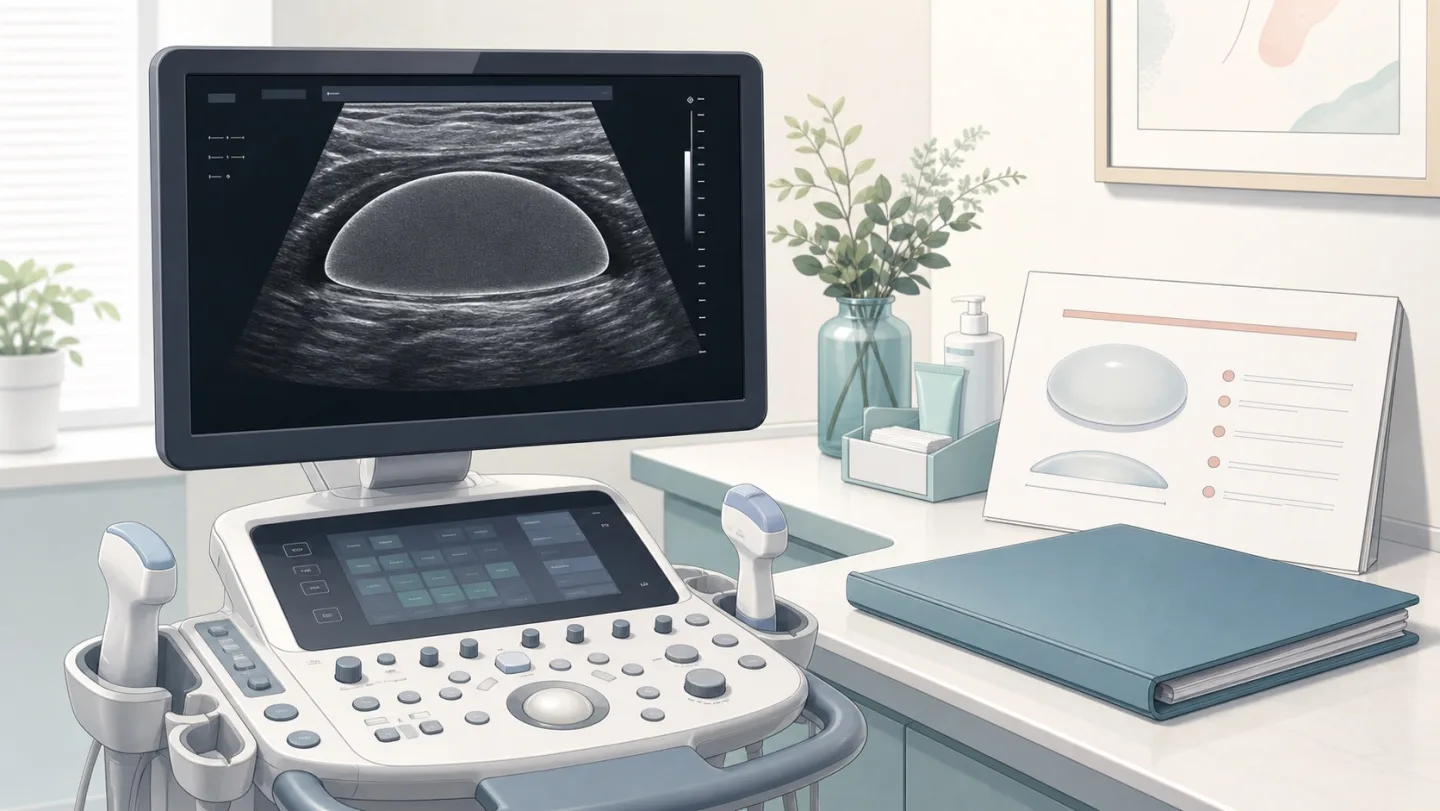
For that reason, silicone implant surveillance may include ultrasound or MRI according to the implant’s labeling, the time since surgery, symptoms, and the recommendation of the treating clinicians. Our guide to mammograms, ultrasound, and MRI after breast augmentation explains the different roles of each test.
Symptoms that should not wait for a routine check
Contact a qualified clinician if you notice a new lump, increasing firmness, shape change, persistent one-sided swelling, redness, drainage, fever, ongoing pain, or a sudden loss of volume. These symptoms do not prove implant failure, but they deserve evaluation.
What international patients should keep
Patients who had breast augmentation in Korea should keep their implant card, operative summary, implant brand and size, surgery date, pocket information, and previous imaging reports. These records help radiologists and surgeons in another country understand the surgical history.
At Ryan Plastic Surgery Clinic in Korea, we encourage patients to maintain both digital and paper copies. Long-term follow-up is easier when the next clinician can see what was placed, where it was placed, and when the surgery occurred.
Frequently asked questions
Do breast implants have to be replaced every 10 years?
No. Ten years is not an automatic replacement deadline. Patients need ongoing follow-up, and revision is based on the implant’s condition, symptoms, imaging, examination, and personal goals.
Can an implant last longer than 10 years?
Yes, some implants remain in place longer, but no implant can be guaranteed for life. The likelihood of complications increases over time.
Do I need surgery if I have no symptoms?
Not necessarily. Asymptomatic patients still need appropriate clinical and imaging follow-up, especially with silicone implants, but surgery is not decided by time alone.
This article provides general education and does not replace an individual examination, implant-specific labeling, or medical advice.
Pingback: Breast Implant Card and Warranty: What to Keep