Breast Implant Decisions and Follow-Up, Part 3 of 9
Are you worried that a breast implant may look or feel obvious because you have little soft-tissue coverage?
What you will learn
- Why rippling can be easier to see or feel in a thin patient.
- How tissue coverage, implant fit, and pocket selection are assessed together.
- Which prevention or correction options may be discussed, including fat grafting.
I am Sangmun Choi, MD, PhD (최상문 박사, 라이안성형외과), a plastic surgeon focusing on breast surgery at Ryan Plastic Surgery Clinic in Seoul. Thin-patient planning was also the subject of my presentation at the 2024 Korean Society of Plastic and Reconstructive Surgeons Autumn Meeting. The practical issue is not simply body weight. It is whether the patient’s own tissues can conceal and support the implant dimensions being considered.
Breast Implant Rippling in Thin Patients: Quick Answer
Breast implant rippling means folds or waves of an implant can be felt or seen through the skin. Thin soft-tissue coverage may make this more noticeable, but BMI alone does not predict it. Prevention or correction may involve implant dimensions, pocket choice, tissue support, fat grafting, or revision after an in-person examination.
What Is Breast Implant Rippling?
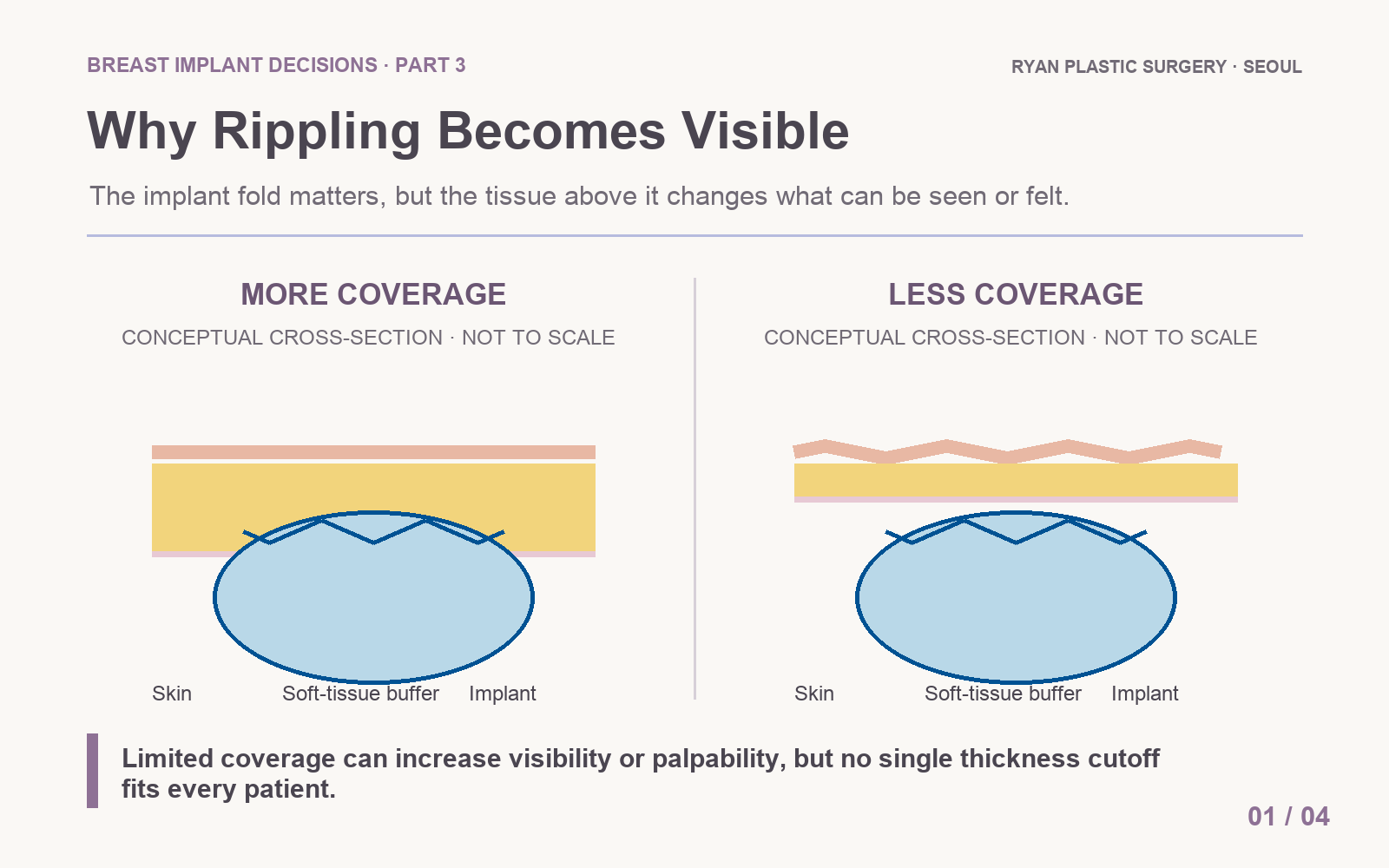
The U.S. FDA defines wrinkling or rippling as implant wrinkling that can be felt or seen through the skin. It is related to implant folds, but what a patient notices also depends on the soft-tissue coverage between the implant and the skin.
Rippling is often most noticeable along the outer or lower breast, where coverage may be thinner, or when a patient leans forward. A mild, stable ripple may be mainly a contour concern. It does not necessarily mean rupture. A sudden change, pain, swelling, firmness, or asymmetry deserves a separate evaluation.
Why Can Rippling Be More Visible in Thin Patients?
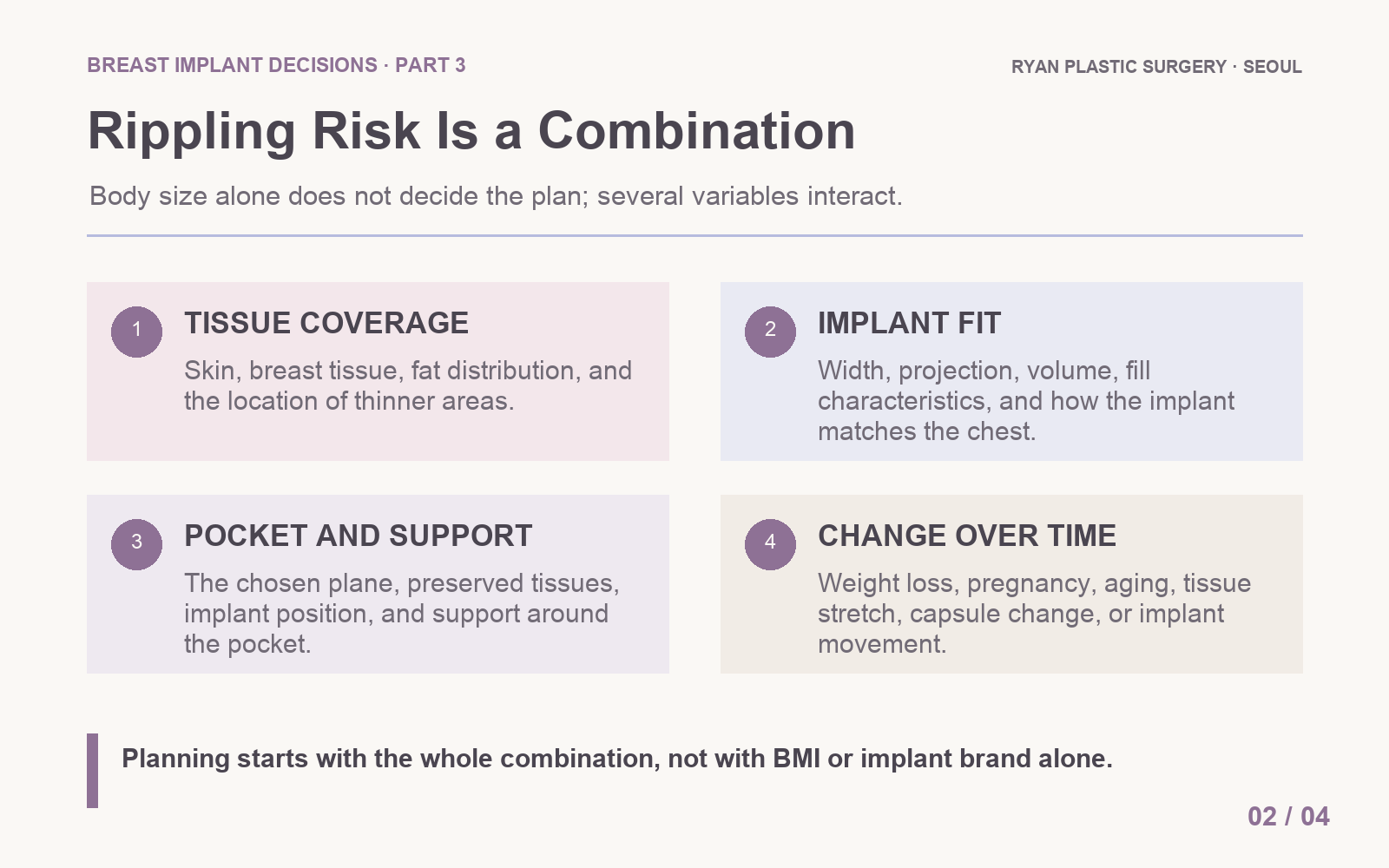
A thin patient may have less breast tissue or subcutaneous fat over parts of the implant. This smaller buffer can make an implant edge or fold easier to see or feel. However, two patients with a similar BMI may have very different breast tissue, skin elasticity, chest width, and fat distribution.
Implant fit matters as well. Excessive implant width, projection, or volume may stretch a limited envelope and reduce the margin for concealment. Implant fill characteristics can also affect the way folds behave, but a device name alone cannot replace anatomy-based planning.
The implant pocket changes the coverage pattern. Submuscular or dual-plane placement may add muscle over part of the upper implant, while movement or animation tradeoffs may matter. Subfascial or subglandular placement keeps the implant above the pectoralis major and avoids muscle division, but relies more heavily on native soft-tissue coverage. A preserved fascial layer is thin; it should not be treated as a substitute for breast tissue or fat. There is no best pocket for every thin patient.
How Is Soft-Tissue Coverage Assessed?
Assessment starts with an in-person examination while standing. The surgeon looks at the upper, medial, lateral, and lower breast; checks asymmetry and skin stretch; measures the breast base; and considers where the tissue is thinnest. Tissue thickness or pinch measurements may help, but no single measurement or universal cutoff can decide the operation for every patient.
For a patient who already has implants, the examination also asks whether the breast has changed with weight loss, pregnancy, aging, capsular contracture, or implant malposition. Ultrasound or MRI may be considered when implant integrity, fluid, a mass, or another complication is in question. Imaging is not automatically required for every stable cosmetic ripple.
| Finding | What it may suggest | What may be discussed |
|---|---|---|
| Thin upper or medial coverage | Implant edge or folds may be easier to see | Implant fit, pocket tradeoffs, and targeted fat grafting |
| Implant dimensions exceed tissue support | More tension, visibility, or position risk | Reconsider width, projection, volume, or profile |
| Stable mild rippling without symptoms | Primarily a contour issue | Observation or elective correction after examination |
| New rippling with firmness or shifting | Capsule or implant-position change may be present | Examination and imaging when indicated |
| Rapid swelling, redness, fever, or severe pain | Not typical simple rippling | Urgent medical evaluation |
How May Rippling Risk Be Reduced Before Surgery?
Prevention begins with proportion. An implant that fits the breast base and available tissue may place less demand on a thin envelope than one chosen mainly by cup-size goals. The plan may compare width, projection, volume, gel characteristics, and how each option behaves in the intended pocket.
Pocket selection is conditional. A muscle-covering option may provide more upper-pole coverage in some patients, while an above-muscle approach may better preserve pectoralis movement in selected patients with adequate tissue. The decision should also account for exercise, animation concerns, asymmetry, the lower fold, and long-term support. Our separate guide compares subfascial, submuscular, and dual-plane breast implant placement.
Fat grafting may add targeted coverage over an implant edge or soften the transition in a selected patient. It can be performed with augmentation or as a staged correction. It does not compensate for a poorly matched implant, and it may require more than one session because available donor fat and long-term retention vary. Possible fat-grafting issues include absorption, firmness, oil cysts, calcification, contour irregularity, and donor-site changes.
What If Breast Implant Rippling Already Exists?
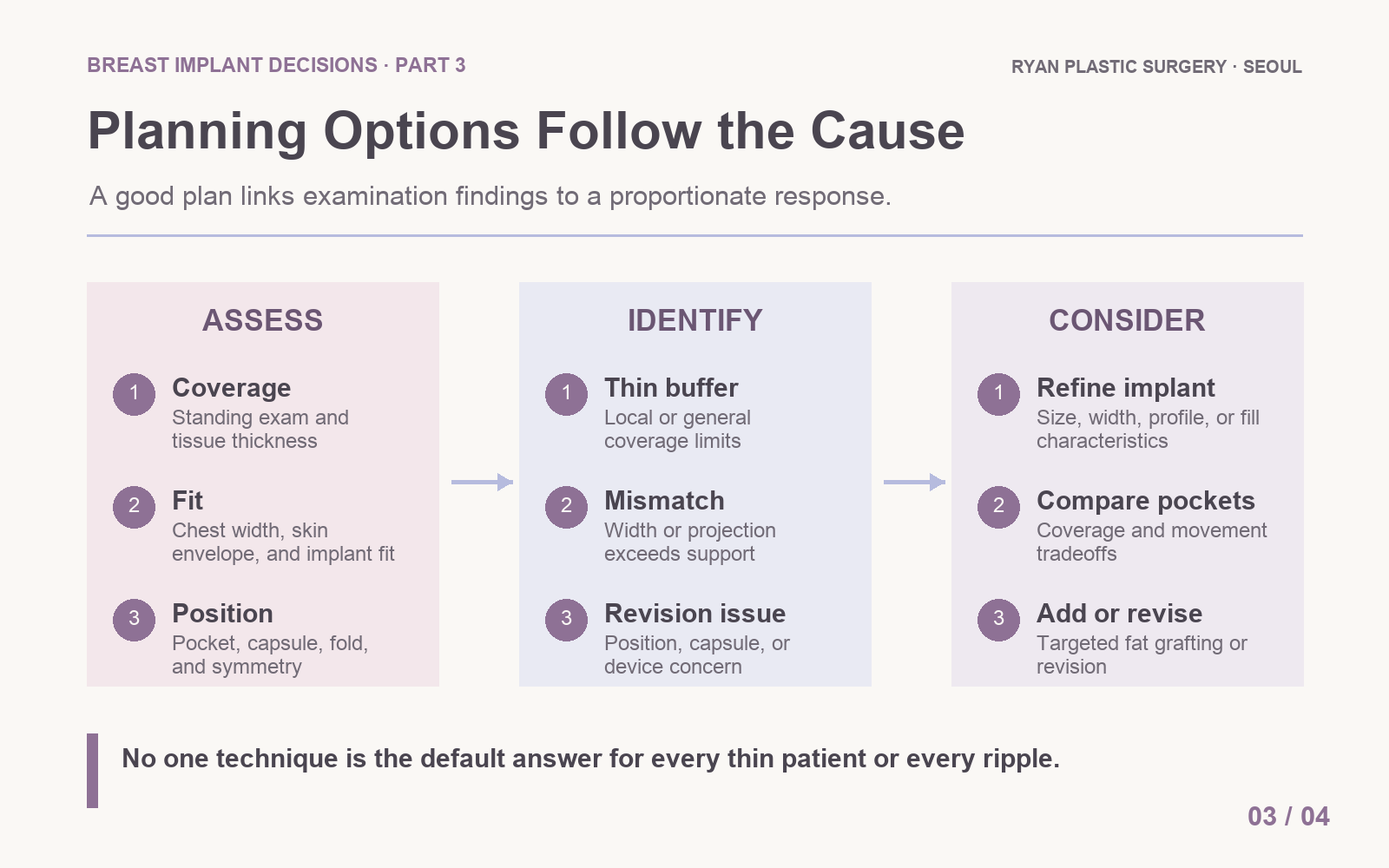
The first step is to identify the cause and decide whether treatment is necessary. A mild ripple that appears only in certain positions may be observed if the implant is stable and the patient is comfortable. Photos alone are not enough to determine whether the issue comes from tissue thickness, implant position, the capsule, device characteristics, or several factors together.
Depending on the examination, options may include targeted fat grafting, exchanging the implant for different dimensions or fill characteristics, changing the pocket, repairing the pocket, or addressing capsular contracture or implant malposition. Each revision adds new scar tissue and surgical risk. A more extensive operation is not automatically better than a focused correction.
For an international patient considering revision in Korea, previous operative notes, implant cards, recent imaging, symptom dates, and clear standing photographs can make remote screening more useful. The final plan still depends on an in-person examination. Breast implants are not lifetime devices, and future follow-up remains necessary even after a satisfactory correction.
When Should You Contact a Surgeon?
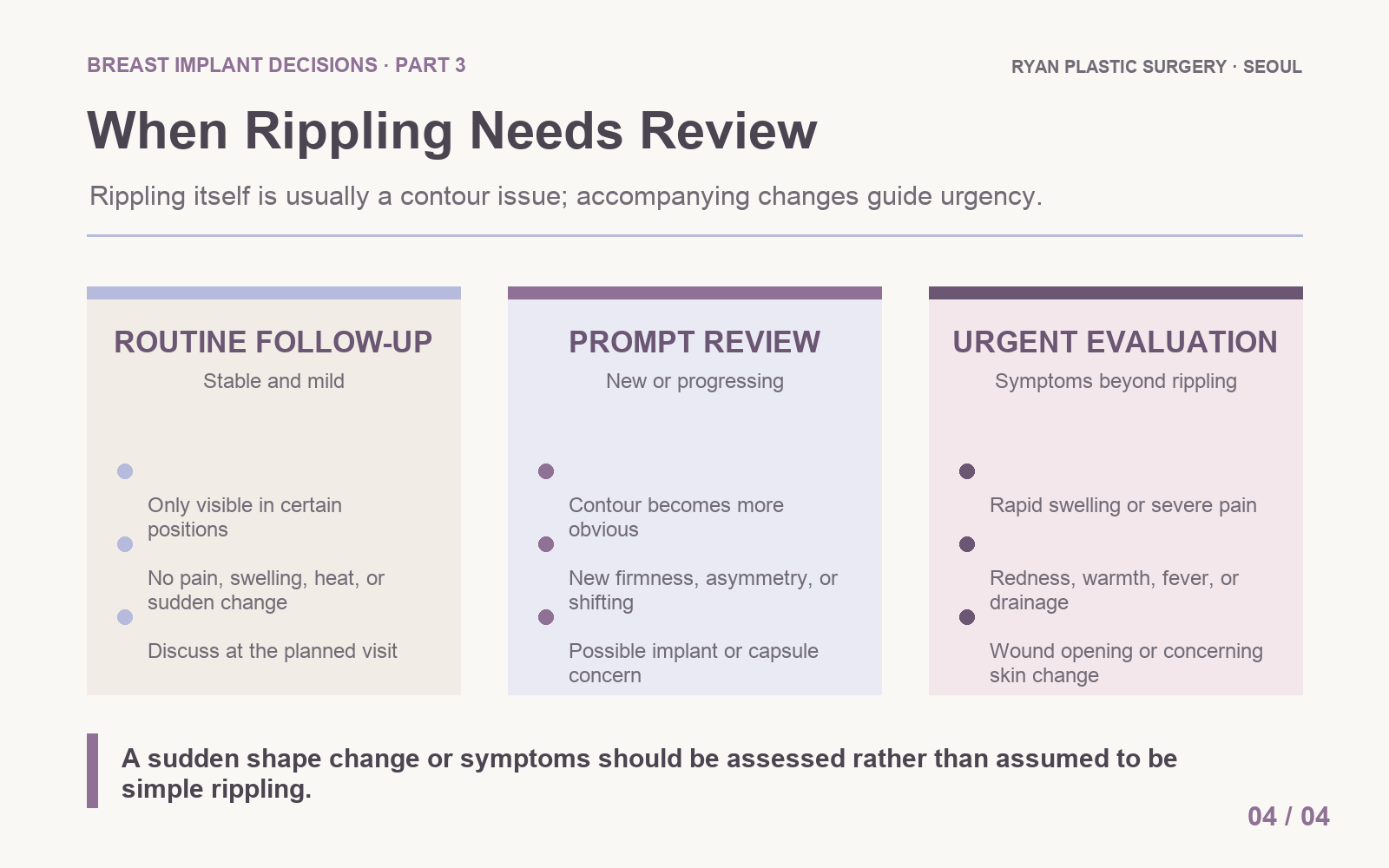
Stable, mild rippling without other symptoms can usually be discussed at a planned follow-up. Arrange a prompt review if the contour is new or worsening, the breast becomes firmer, the implant seems to have shifted, or asymmetry develops.
Seek urgent medical evaluation for rapid swelling, severe or increasing pain, redness, warmth, fever, drainage, wound opening, or a concerning skin change. These findings should not be assumed to be simple rippling. Infection, fluid collection, bleeding, rupture, or another condition may require assessment.
A Practical Summary for Thin Patients
Breast implant rippling in thin patients is usually a coverage and planning problem rather than a single-device problem. The useful questions are: Where is the tissue thinnest? Does the implant fit the breast base and skin envelope? Which pocket offers an acceptable balance of coverage and movement? Would targeted fat grafting add value, or would it simply mask a larger mismatch?
At Ryan Plastic Surgery Clinic in Seoul, these decisions are made conditionally after examination. The aim is to reduce avoidable visibility while preserving tissue and choosing a proportionate operation. No plan can eliminate all rippling or guarantee that revision will never be needed.
Frequently Asked Questions
Does breast implant rippling mean the implant has ruptured?
No. Rippling can occur with an intact implant when folds are visible or palpable through limited coverage. A new shape change, pain, swelling, firmness, or asymmetry may justify examination and imaging to check for rupture or another problem.
Can fat grafting completely fix breast implant rippling?
Fat grafting may improve selected thin areas, but it cannot promise complete correction. Donor-fat availability, graft retention, implant fit, pocket position, and capsule condition all matter, and more than one session may be needed.
Is subfascial placement always best for a thin patient?
No. Subfascial placement preserves the pectoralis muscle and may suit selected patients, but a thin fascial layer does not replace soft-tissue volume. The choice between subfascial, subglandular, dual-plane, or submuscular placement depends on anatomy and goals.
Discuss Your Tissue Coverage and Implant Plan
A remote review can organize your questions and records, but final recommendations require an in-person examination in Seoul.
References
- U.S. Food and Drug Administration. Risks and Complications of Breast Implants. Updated December 14, 2023.
- Stevens WG, et al. Fat Grafting and Breast Augmentation: A Systematic Review of Primary Composite Augmentation. Plastic and Reconstructive Surgery Global Open.
- Graf RM, et al. A Comprehensive Outcome Review of Subfascial Breast Augmentation over a 10-Year Period. Plastic and Reconstructive Surgery.
- Wong CH, et al. Subfascial Breast Augmentation: A Systematic Review and Meta-Analysis of Capsular Contracture. Aesthetic Surgery Journal.
Last medically reviewed: August 9, 2026
Medical disclaimer: This article provides general education and does not diagnose a complication or replace an individual consultation. Breast augmentation, fat grafting, and revision surgery may involve bleeding, infection, delayed healing, changes in sensation, asymmetry, capsular contracture, implant malposition, rupture, fat absorption, oil cysts, calcification, contour irregularity, anesthesia-related problems, and possible revision surgery. Seek local urgent care for severe or rapidly worsening symptoms.
Pingback: Breast Implant Follow-Up Schedule | Korea