
I am Sangmun Choi, MD, PhD (최상문 박사, 라이안성형외과), a plastic surgeon at Ryan Plastic Surgery Clinic in Seoul. Motiva Preservé uses a subfascial or subglandular pocket above the pectoralis major. The clinical question is which plane can support the implant while preserving native breast tissues as carefully as possible.
Quick answer: Motiva Preservé in Korea uses a subfascial or subglandular pocket. Preservé places greater emphasis on preserving native tissue than conventional pocket dissection through measured planning and controlled tissue separation. The plane is chosen after an in-person examination; another pocket, a lift, fat grafting, or postponement may be safer.

A smaller incision or different early recovery may be discussed, but the core concept is tissue-preserving creation of a subglandular or subfascial space. Incisions, recovery variation, and implant risks remain.
What is Motiva Preservé: plane plus tissue preservation?
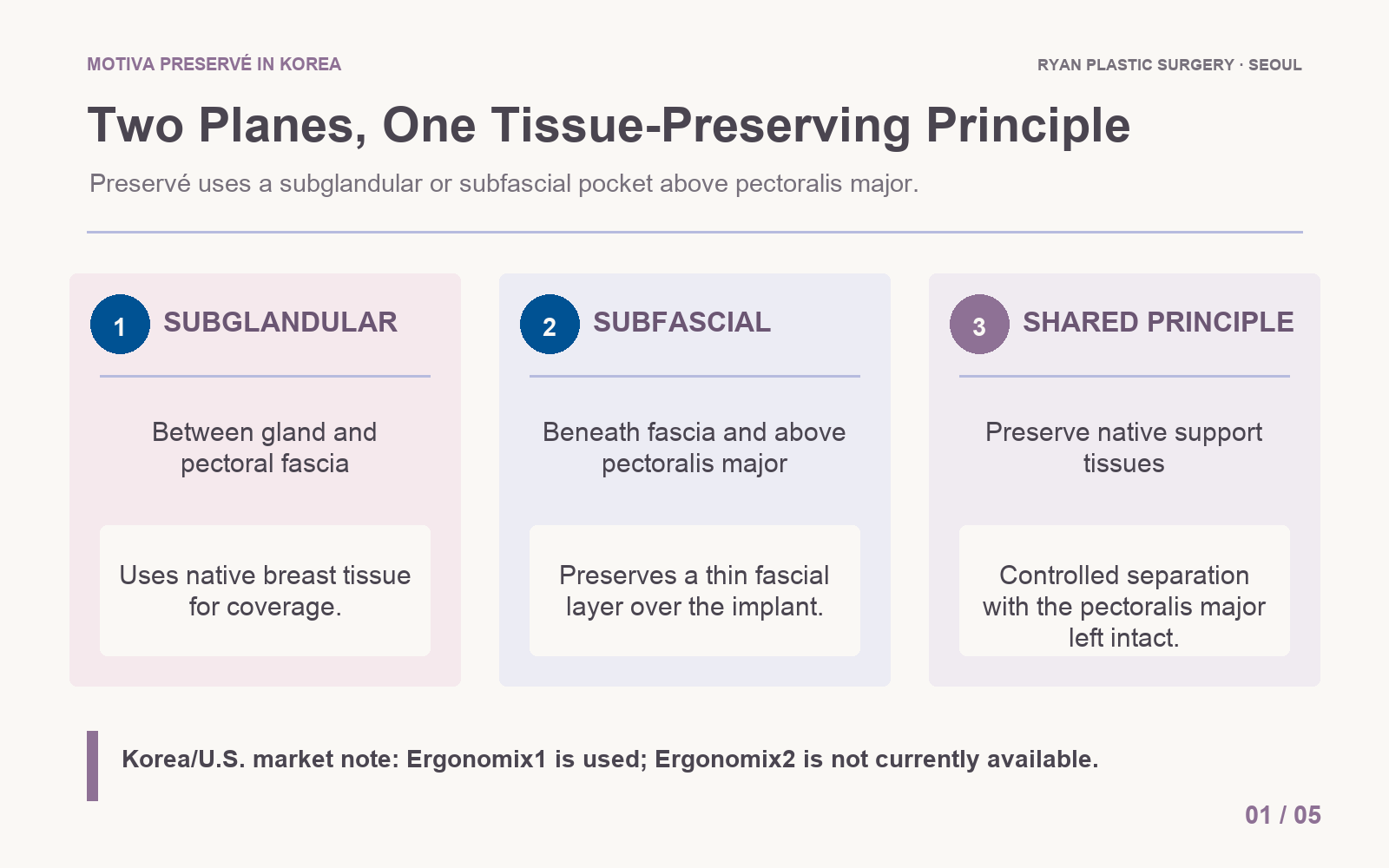
Preservé is Motiva’s branded breast-tissue-preservation system. It combines device-specific planning, specialized pocket tools, and a market-appropriate implant. The pocket is subglandular or subfascial, with the pectoralis major left intact and unnecessary disruption of native breast tissue support structures minimized.
The plane alone does not define Preservé. Conventional augmentation can also use either plane. Preservé adds calibrated dimensions and controlled tissue separation to preserve native breast tissue support structures. It shares goals with other tissue-preserving augmentation, but its tools and details differ.
Where is the implant placed: subfascial or subglandular?
In a subglandular plane, the implant is between the breast gland and the pectoral fascia. In a subfascial plane, it is beneath the pectoral fascia and above the pectoralis major. Both preserve the muscle. Selection depends on coverage, fascia, dimensions, skin support, and chest anatomy.
Subfascial placement may retain a thin fascial layer over the implant; subglandular placement may fit patients with suitable native coverage. Neither guarantees invisible edges or a complication-free result. Compare subfascial, submuscular, and dual-plane placement.
| Point | Subglandular Preservé | Subfascial Preservé |
|---|---|---|
| Anatomic location | Between the breast gland and pectoral fascia | Beneath fascia and above pectoralis major |
| Coverage question | Does native breast tissue provide suitable coverage? | Can the fascia be preserved as an additional thin layer? |
| Shared principle | Above-muscle placement with controlled tissue separation | Above-muscle placement with controlled tissue separation |
| What it cannot promise | Invisible edges, no pain, or no future revision | Invisible edges, no pain, or no future revision |
Which implant is used for Preservé in Korea and the United States?
As of this update, Preservé in South Korea and the United States uses Motiva SmoothSilk Ergonomix, the first-generation model, often called Ergonomix1. Ergonomix2 is not currently available for Preservé in either market. Global Motiva materials may describe other country-specific configurations.
Patients traveling to Korea should rely on the local implant label and size matrix. At Ryan Plastic Surgery Clinic, the option is confirmed during in-person planning and documented on the implant card.
Who may be considered for Preservé?
Candidacy begins by asking whether either plane can cover and support the planned implant. Preservé planning assesses the breast base, fascia, skin, lower pole, and whether the proposed dimensions create excessive tension.
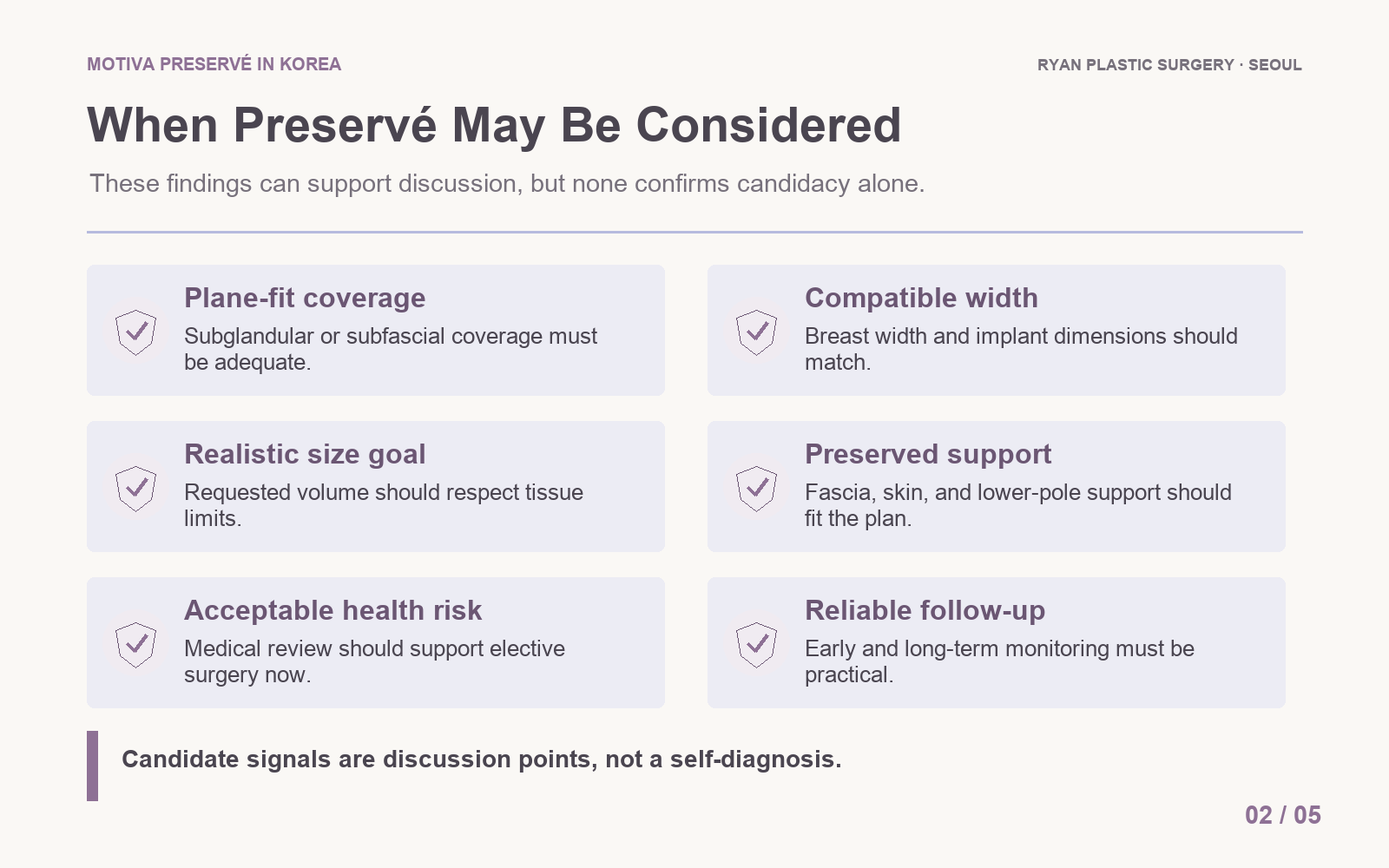
A patient may be considered when the following findings work together:
- Adequate coverage: tissue may conceal implant edges.
- A suitable plane: subglandular or subfascial placement may fit the fascia and thickness.
- Compatible dimensions: base width and projection may fit.
- A realistic size: volume may remain within tissue tolerance.
- Medical fitness: health may support healing.
- Reliable follow-up: early and long-term checks are practical.
Both planes keep the implant above the pectoralis major, which may reduce muscle-driven distortion. Preservé also prioritizes fascia, glandular tissue, ligaments, and lower-pole support. Exercise alone does not establish candidacy. See muscle preservation for active women.
When might another plan be safer?
Implant surgery should not proceed during an active infection, untreated breast cancer or pre-cancer, or while a patient is pregnant or nursing. New illness, skin problems, medication changes, or possible pregnancy should be disclosed.
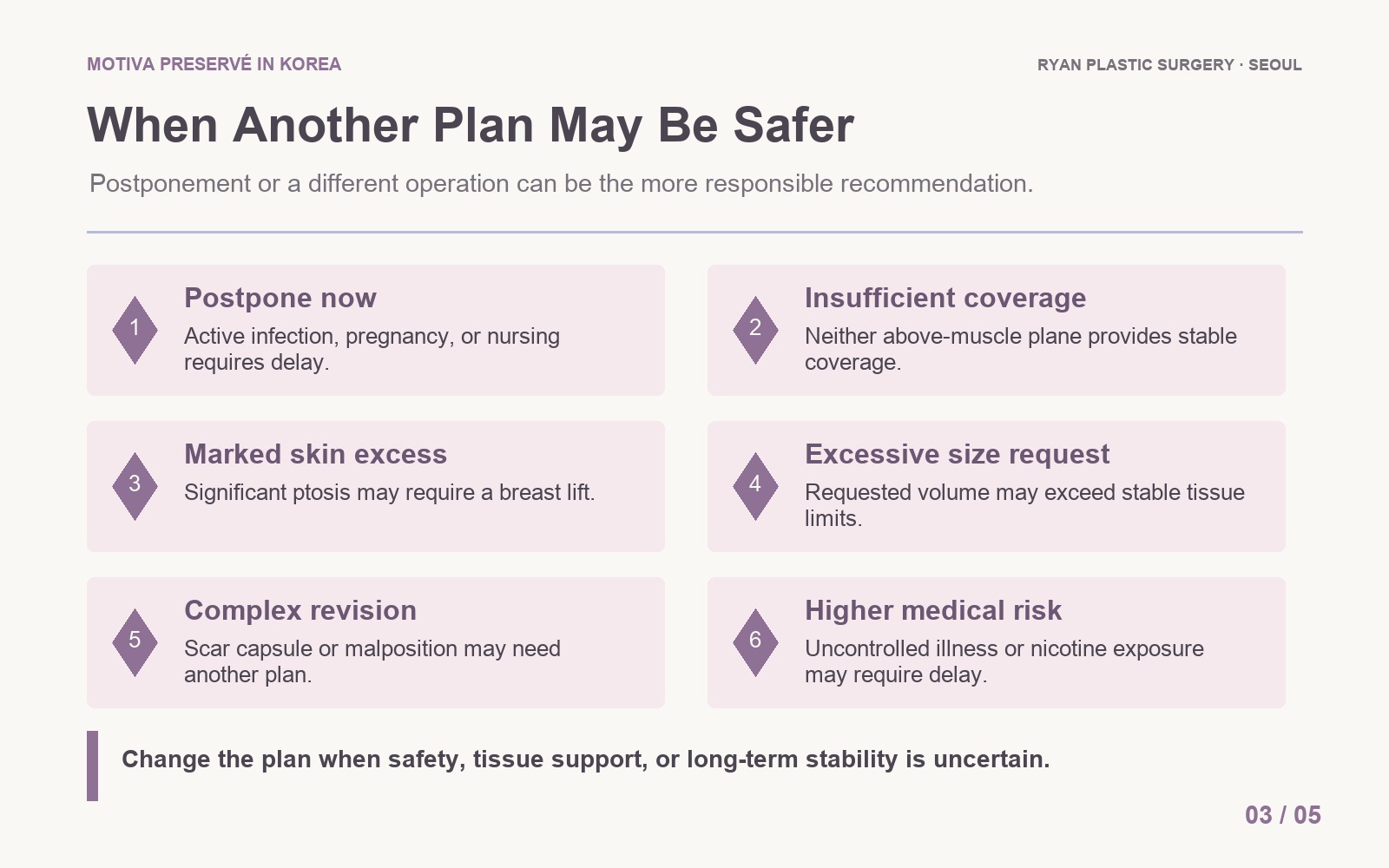
Inadequate tissue coverage in both planes, radiation injury, poor blood supply, marked skin excess, or excessive implant dimensions may favor another plan. Significant ptosis may need a lift; complex revision may require different pocket work.
Nicotine, uncontrolled illness, clotting concerns, or medications that affect bleeding may require treatment or postponement. An online photograph cannot decide this.
How is the plan built during an in-person consultation?
In person, I assess chest shape, footprint, asymmetry, skin, glandular coverage, fascia, tissue thickness, nipple position, scars, and the pectoralis relationship. These findings determine subglandular, subfascial, or another approach. Health and travel can change the recommendation.

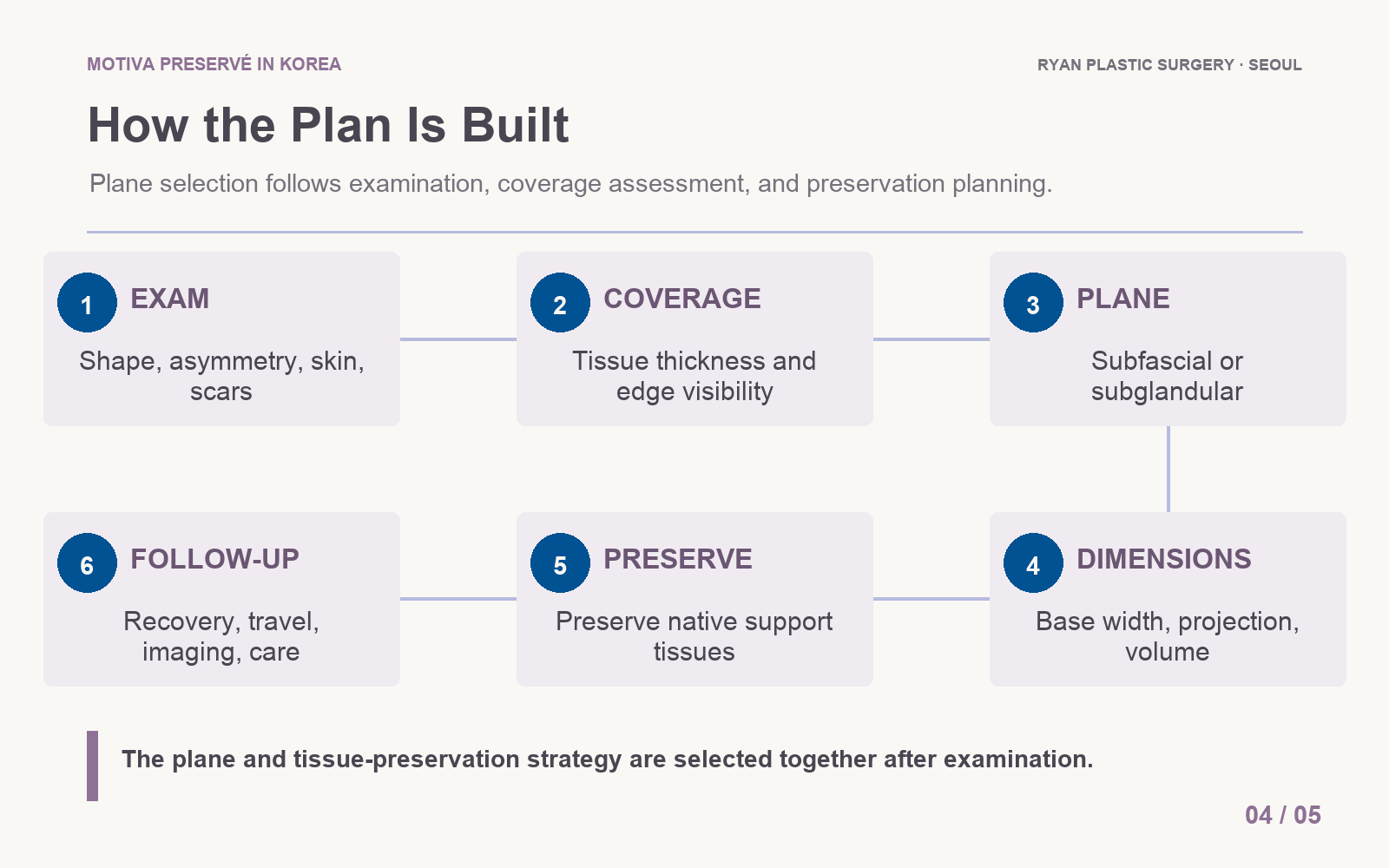
Base width, projection, weight, and tissue stretch matter more than cc alone. See implant size, base width, and profile and Motiva implants in Korea.
The consultation compares both Preservé planes with other pockets or a lift. It also sets pocket boundaries, tissue-preservation goals, incision, anesthesia or sedation, restrictions, and reasons to change course.
What about thin patients and fat grafting?
Thin patients need closer comparison of the two planes. Subfascial placement may preserve a thin fascial layer, but fascia is not thick coverage. Conservative dimensions and targeted fat grafting may soften selected edges; fat survival and donor volume vary.
Fat grafting cannot guarantee hidden rippling or make every thin patient suitable. Insufficient coverage may favor another pocket. See augmentation for thin patients with optional fat grafting.
Can Preservé change early recovery?
Both planes remain above the pectoralis major, so selected patients may have less muscle-related tightness than after an under-muscle operation. Controlled tissue handling may also limit unnecessary dissection. Pain, swelling, medication, and restrictions still vary.

Many international patients plan about one week in Seoul; staying longer may allow more observation. One week is not automatic flight clearance. See how long to stay in Korea and the international-patient journey.
Infection remains possible. Antibiotics may be prescribed but do not remove that risk. Increasing redness, drainage, fever, one-sided swelling, severe pain, chest pain, or shortness of breath needs prompt assessment.
What are the main limitations?
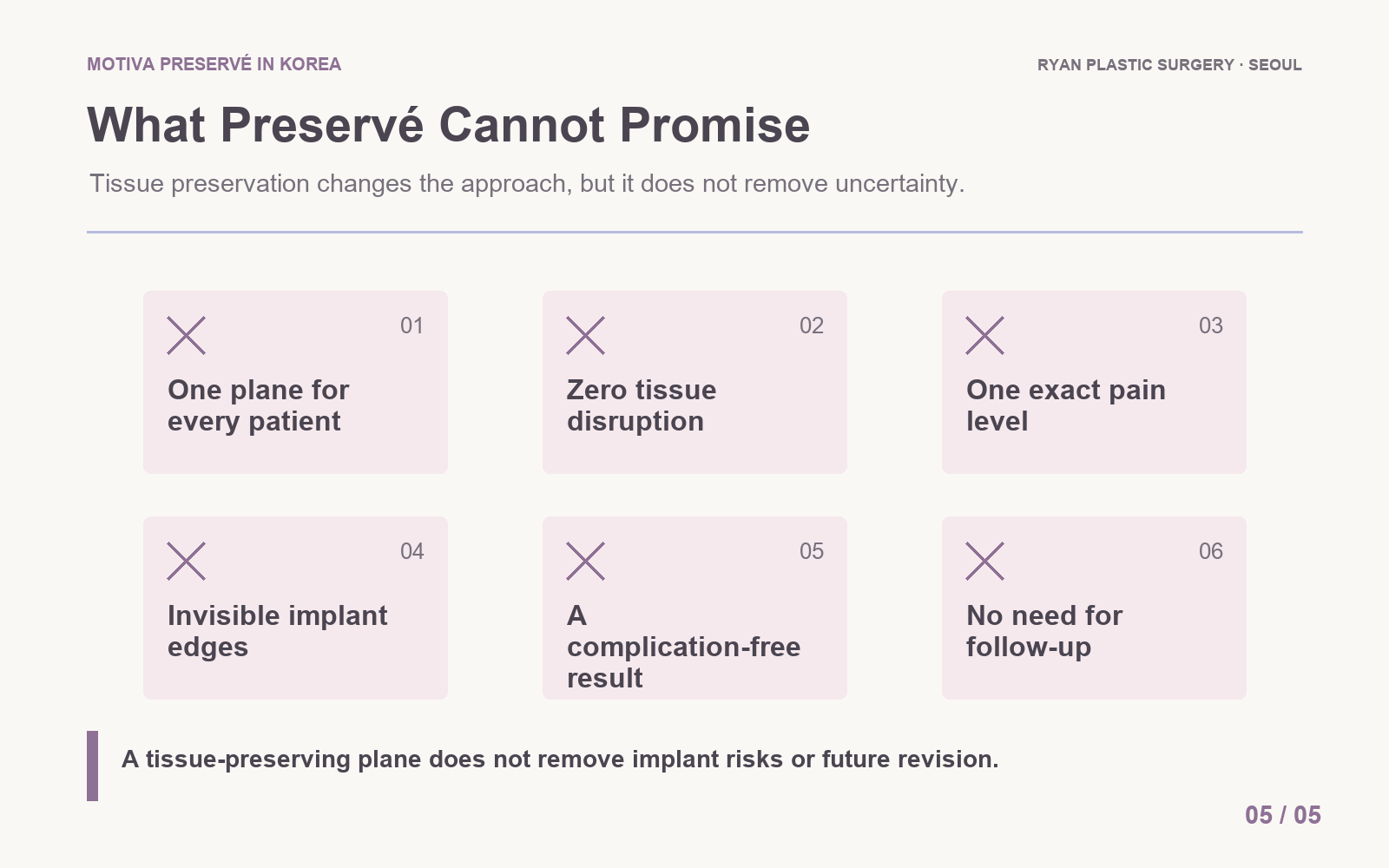
Plane selection alone does not guarantee tissue preservation or a better outcome. Dissection, dimensions, tissue tension, sterility, healing, and follow-up matter. Device evidence is not the same as procedure-specific evidence. The FDA Motiva implant study supports the approved devices, but it did not test every Preservé tool or subglandular and subfascial workflow as one technique.
Preservé materials include implant research, technical studies, and manufacturer data on file. Independent long-term evidence for the complete pathway remains limited. Ergonomix2 publications are not direct evidence for the Ergonomix1 configuration used with Preservé in Korea or the United States.
| Question | What Preservé may change | What still remains |
|---|---|---|
| Plane choice | Subglandular or subfascial placement may be selected to match coverage. | Neither plane guarantees invisible edges or perfect support. |
| Tissue handling | Controlled separation may reduce disruption of native support tissues. | Incision, tissue trauma, swelling, and scar formation still occur. |
| Pain and recovery | Some patients may have less muscle-related discomfort. | Pain, restrictions, and recovery dates still vary. |
| Breast shape | Implant dimensions may improve volume and proportion. | Marked sagging or asymmetry may need a lift or another operation. |
| Long-term safety | Modern implant and no-touch planning may support risk reduction. | Capsular contracture, rupture, malposition, infection, and revision remain possible. |
Risks and long-term follow-up still matter
Possible complications include bleeding, infection, altered sensation, asymmetry, implant malposition, rippling, seroma, capsular contracture, rupture, anesthesia-related problems, and revision surgery.
Breast implants are not lifetime devices. Even after a smooth early recovery, future evaluation may be needed for pain, firmness, shape change, asymmetry, suspected rupture, malposition, or patient preference. Continue age- and risk-appropriate breast screening and tell the imaging center that you have implants.
Our guides to mammograms, ultrasound, and MRI after augmentation and implant longevity and replacement explain why follow-up continues beyond the surgical trip. Patients can also review Dr. Sangmun Choi’s training and breast-surgery focus before arranging a consultation.
Frequently asked questions
Does Preservé use a subfascial or subglandular plane?
It may use either. Subglandular is between gland and fascia; subfascial is beneath fascia and above pectoralis major. Anatomy selects the plane. Preservé also describes tissue-preserving pocket creation, so neither plane label alone defines it.
Is Ergonomix2 used with Preservé in Korea?
No. South Korea and the United States use SmoothSilk Ergonomix, often called Ergonomix1. Ergonomix2 is not currently available for Preservé in either country.
Can a very thin patient have Preservé?
Possibly, if subglandular or subfascial coverage fits the dimensions. Fat grafting may support selected areas; inadequate coverage may favor another pocket.
Can Preservé correct sagging breasts?
Augmentation may improve volume, but significant skin excess or nipple descent may require a breast lift. Preservé does not replace a necessary lift.
Is recovery always faster?
No. Avoiding pectoralis disruption may change early comfort, but recovery depends on the operation, tissue response, complications, and health. Work, exercise, and travel timing remain individual.
Is the Preservé technique separately FDA approved?
Motiva SmoothSilk Round and SmoothSilk Ergonomix implants received FDA approval in 2024. Device approval is not a separate FDA conclusion about every Preservé detail.
The bottom line
Motiva Preservé in Korea may use a subglandular or subfascial plane. Anatomy determines the plane; controlled pocket creation and preservation of native breast tissues define the approach.
If neither plane is suitable, another pocket, a lift, staged fat grafting, a smaller implant, or postponement may improve coverage or safety.
This article provides general education and does not replace an individual examination, diagnosis, informed-consent discussion, surgical recommendation, or emergency care. Availability, approved indications, and device configurations can differ by country. Follow the instructions of your operating surgeon and seek prompt local assessment for urgent symptoms.
References
- Motiva: Preservé patient information for markets where Ergonomix2 is available
- Motiva: Subglandular and subfascial breast implant placement
- Motiva: Implant overview and United States availability note
- Establishment Labs: Preservé Healthcare Professional Catalogue, version 1.5
- U.S. FDA: Motiva Implants Summary of Safety and Effectiveness Data
- U.S. FDA: Risks and Complications of Breast Implants