I am Sangmun Choi, MD, PhD (최상문 박사, 라이안성형외과), a plastic surgeon in Seoul specializing in breast surgery and international patient care. For someone considering breast augmentation in Korea for international patients, the operation is only one part of the plan. The full journey begins before the first message and continues after the flight home.
Quick answer: A well-planned international breast augmentation journey includes remote information sharing, an in-person examination, individualized implant and technique decisions, surgery, early follow-up in Seoul, medical clearance for travel, and a practical remote follow-up plan.
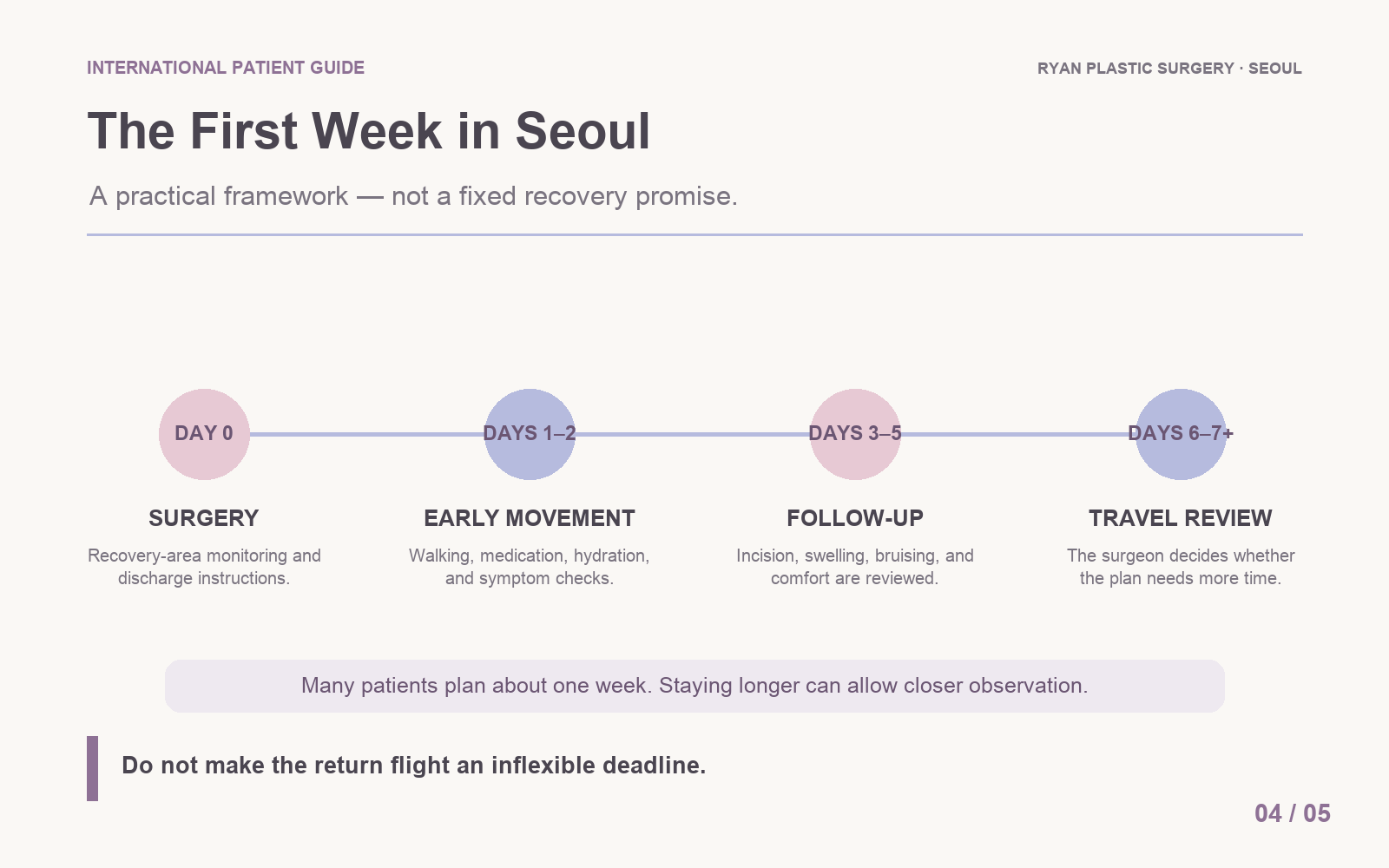
At Ryan Plastic Surgery Clinic in Korea, we commonly plan about one week in Seoul for international patients. Staying longer can be helpful because it allows more time to observe swelling, incision healing, comfort, and the overall recovery trend. A return ticket, however, should never become a deadline that overrides medical judgment.
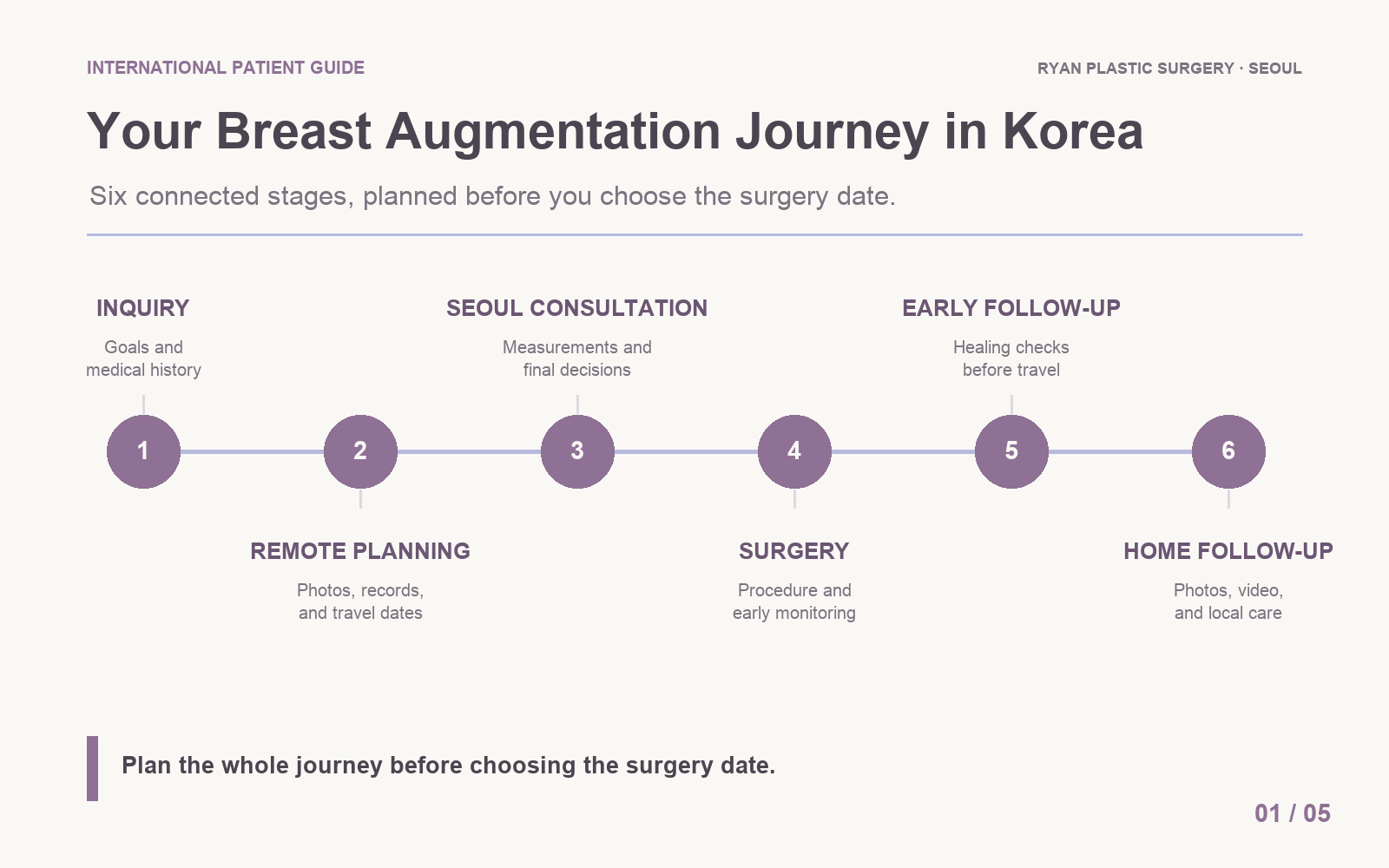
1. Before the first inquiry: define the journey, not only the cup size
Start with the result you hope to achieve, but also think about timing, work, family duties, exercise, flight length, and how much recovery support you will have at home. A reference photograph can communicate a direction such as subtle, balanced, or fuller. It cannot promise that another person’s result can be copied.
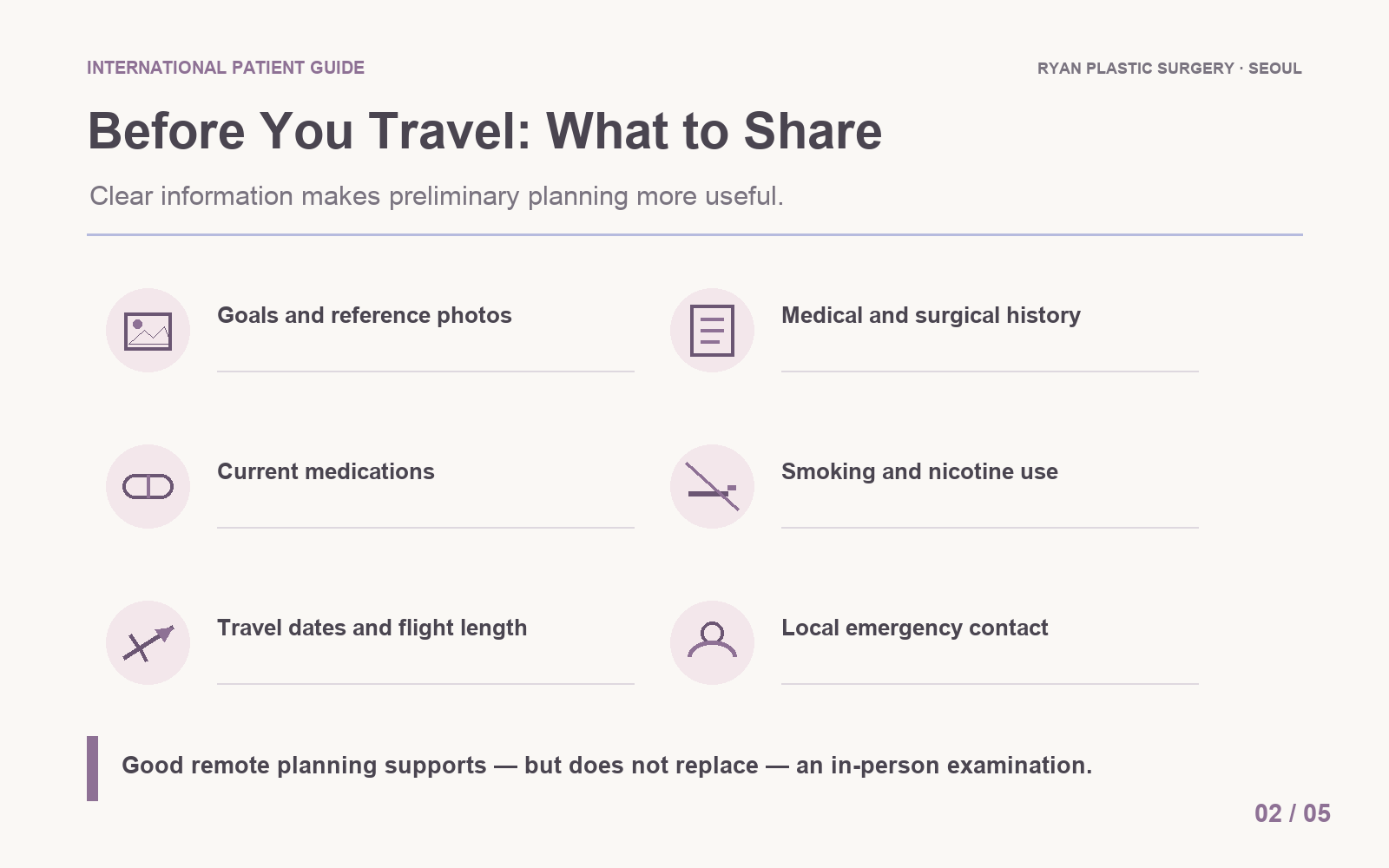
Prepare a concise medical summary. Include previous breast or chest surgery, major medical conditions, allergies, current medication and supplements, pregnancy or breastfeeding history when relevant, and all smoking or nicotine use. Do not stop prescribed medication without advice from the prescribing clinician and surgical team.
For a broad introduction to procedures and terminology, read our 2026 breast augmentation overview for international patients. The separate guide Is Breast Augmentation in Korea Safe? explains why informed consent, qualified care, and realistic risk discussion matter.
2. Remote inquiry: what can be planned before you travel?
A remote inquiry can help organize the trip, identify obvious questions, and estimate which consultations or tests may be needed. Useful information includes your goals, clear non-edited photographs, height and weight, previous procedures, medication, nicotine exposure, preferred travel window, flight length, and the country where you will recover after returning home.
Remote photographs have limits. They cannot show tissue thickness, skin stretch, breast base width, rib shape, implant mobility, or subtle asymmetry as accurately as a direct examination. A preliminary discussion is therefore a planning tool, not a final diagnosis or surgical recommendation.
You can also review Dr. Sangmun Choi’s training and breast-surgery focus before deciding whether to arrange a consultation.
3. Arrival in Seoul: the final plan is made in person
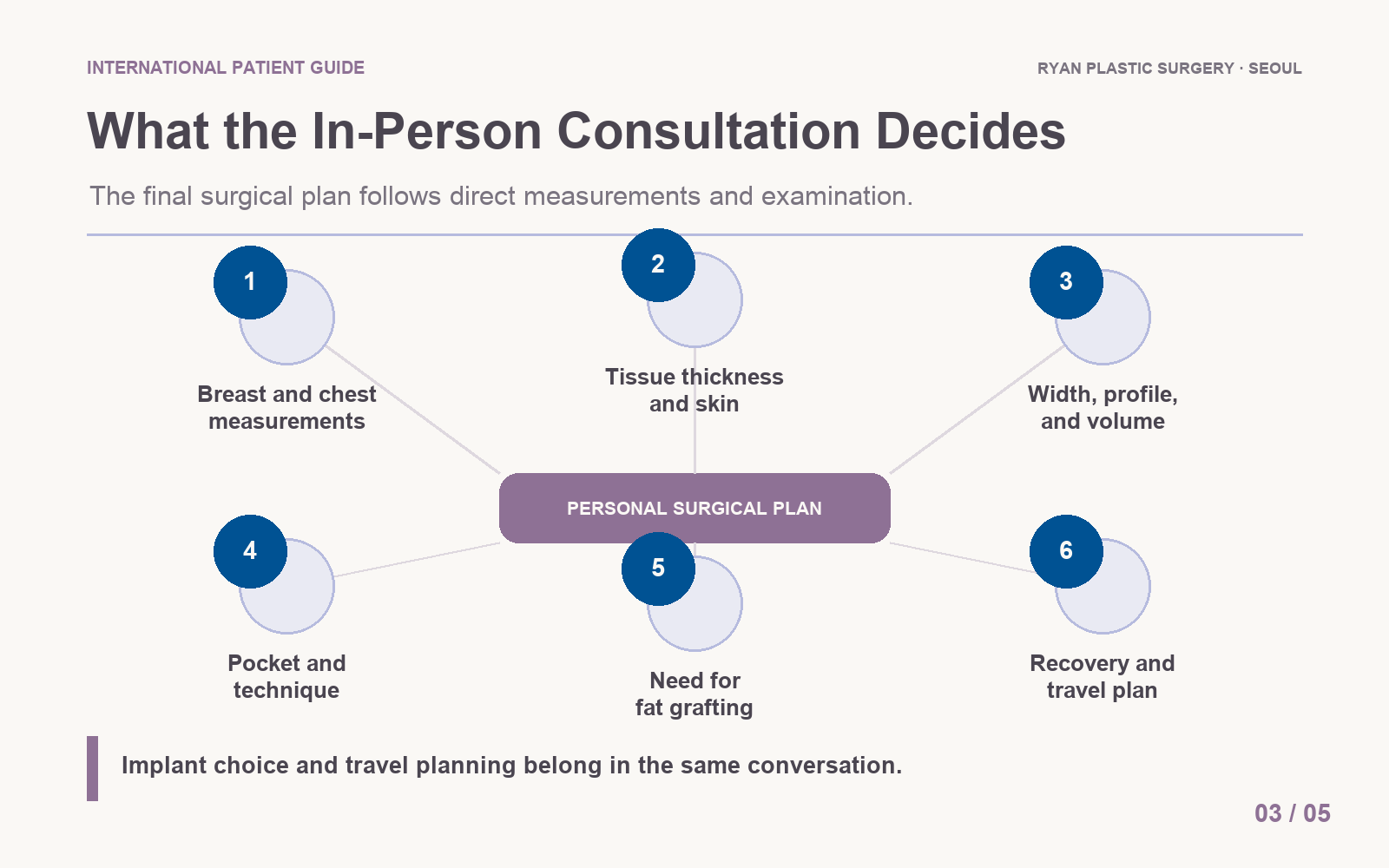
The in-person consultation is where the preliminary plan becomes specific. The surgeon examines chest-wall shape, breast footprint, tissue thickness, skin quality, asymmetry, nipple position, and the relationship between the breast and pectoralis muscle. Your health history and travel schedule are reviewed again because both can change the plan.
Implant volume in cc is only one variable. Width and profile must fit the breast footprint and desired silhouette. Our guide to choosing breast implant size in Korea explains why equal volumes can look different on different bodies.
Implant features are discussed in the guide to Motiva implants in Korea. The pocket decision is equally important; compare subfascial, submuscular, and dual-plane placement before assuming that one plane is best for everyone.
Selected patients may be candidates for a tissue-preserving or Preservé approach. Thin patients may need additional coverage planning, including selective fat grafting; see our guide to breast augmentation for thin patients. Patients who exercise frequently may also want to understand muscle preservation and animation deformity.
4. Before surgery and on the day of surgery
Follow the clinic’s exact instructions for fasting, medication, nicotine avoidance, arrival time, clothing, and transportation. Arrange an adult companion or approved support when instructed. Do not hide a new illness, fever, skin problem, medication change, or possible pregnancy because postponing surgery may sometimes be safer than proceeding.
Before consent, the plan should cover the implant, incision, pocket, expected recovery, alternatives, and material risks. Breast augmentation can involve bleeding, infection, delayed healing, changes in sensation, asymmetry, implant malposition, rippling, capsular contracture, rupture, anesthesia complications, and possible revision surgery.
After surgery, patients are observed until the medical team considers them stable for discharge. Medication may include pain control and, when prescribed, antibiotics. Take every medication exactly as directed. Antibiotics can be part of an infection-risk reduction plan, but they do not remove the possibility of infection.
5. The first week in Seoul
Early recovery is about trends. Pain, tightness, swelling, bruising, arm movement, appetite, sleep, and incision appearance can change over several days. Gentle walking is commonly encouraged when appropriate, while lifting, strenuous exercise, and chest training remain restricted until the surgeon advances activity.
At our clinic, many international patients plan about one week in Korea and return home after early follow-up. Staying longer is always worth considering when the itinerary allows it, especially after a more complex operation, an unexpected recovery change, or a very long flight. Read the detailed guide on how long to stay in Korea after breast augmentation.
6. When is it appropriate to fly home?
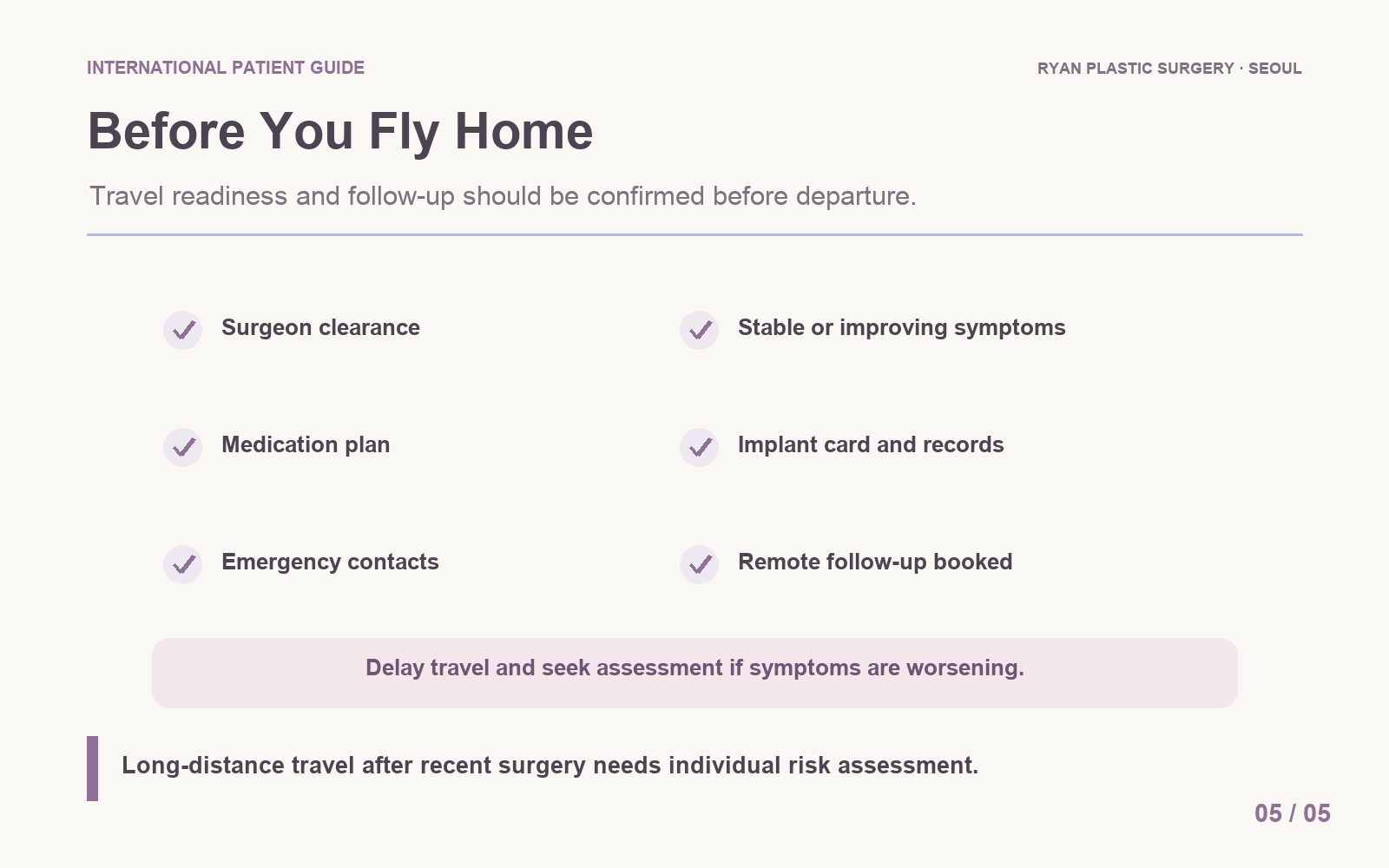
There is no single flight date that is correct for every patient. The operating surgeon should review the length of the flight, mobility, medical history, clotting risk, medications, symptoms, and examination findings before giving individual travel guidance.
Recent surgery and long-distance travel can both increase blood clot risk. The CDC Yellow Book gives conservative medical-tourism guidance to avoid flying for 10 days after chest or abdominal surgery. This public-health guidance is one reason to build flexibility into the itinerary and discuss any personal risk factors before booking a non-changeable flight.
Travel should be delayed and the patient reassessed if symptoms are worsening. Rapid one-sided swelling, uncontrolled bleeding, increasing redness, drainage, fever, severe or escalating pain, fainting, chest pain, or shortness of breath require prompt medical attention. Chest pain or breathing difficulty can be an emergency.
7. What to carry home
- Implant card with the manufacturer, model, size, and serial information
- Operative summary and the implant pocket used
- Medication list and wound-care instructions
- Activity, showering, garment, and sleeping-position instructions
- Clinic contact details and clear emergency guidance
- The date and method of the next remote follow-up
Keep digital copies that can be shared with a radiologist or local surgeon. If another clinician evaluates the breast later, the implant record and operative information can make that assessment more useful.
8. Remote follow-up after you return home
Remote follow-up may use standardized photographs, symptom updates, and video consultation. Images should be taken in consistent lighting and positions when the clinic requests them. Remote review is useful for tracking recovery, but it cannot replace a hands-on examination, ultrasound, laboratory testing, or emergency care when those are needed.
Long-term care continues after the early swelling settles. Learn how mammograms, ultrasound, and MRI are used after breast augmentation. Breast implants do not have a universal ten-year expiration date, but they are not lifetime devices; our guide explains when implant replacement or revision may be considered.
A breast that becomes progressively firm, higher, distorted, or painful deserves evaluation. The guide to capsular contracture after breast augmentation explains early signs and why not every firm breast has the same cause.
Frequently asked questions
Can the final implant size be chosen during an online consultation?
No. Remote discussion can clarify preferences and likely options, but the final size, profile, pocket, and technique should follow direct measurements and examination.
Is one week in Korea always enough?
No. About one week is a common planning framework at our clinic, not a universal clearance rule. Some patients should stay longer because of the procedure, recovery findings, medical risk, or flight itinerary.
What happens if I have a concern after returning home?
Contact the clinic promptly with the requested photographs and a clear symptom timeline. Seek local in-person or emergency care when symptoms are urgent or cannot be assessed safely from a distance.
Do I still need breast screening after implants?
Yes. Continue age- and risk-appropriate breast screening and tell the imaging center that you have implants. Implant-specific ultrasound or MRI may also be recommended according to symptoms, device labeling, and clinician guidance.
The bottom line
Breast augmentation in Korea for international patients works best when the trip is planned as one connected medical journey. The first inquiry, in-person decisions, surgery, recovery in Seoul, return travel, and remote follow-up all affect one another.
A clear plan cannot eliminate every complication, but it can reduce avoidable uncertainty and make it easier to respond when recovery does not follow the expected course.
This article provides general education and does not replace an individual examination, diagnosis, surgical recommendation, or travel clearance. Follow the instructions of your operating surgeon and seek urgent local care for emergency symptoms.
Pingback: Choose a Breast Surgeon in Seoul: 9 Safety Questions